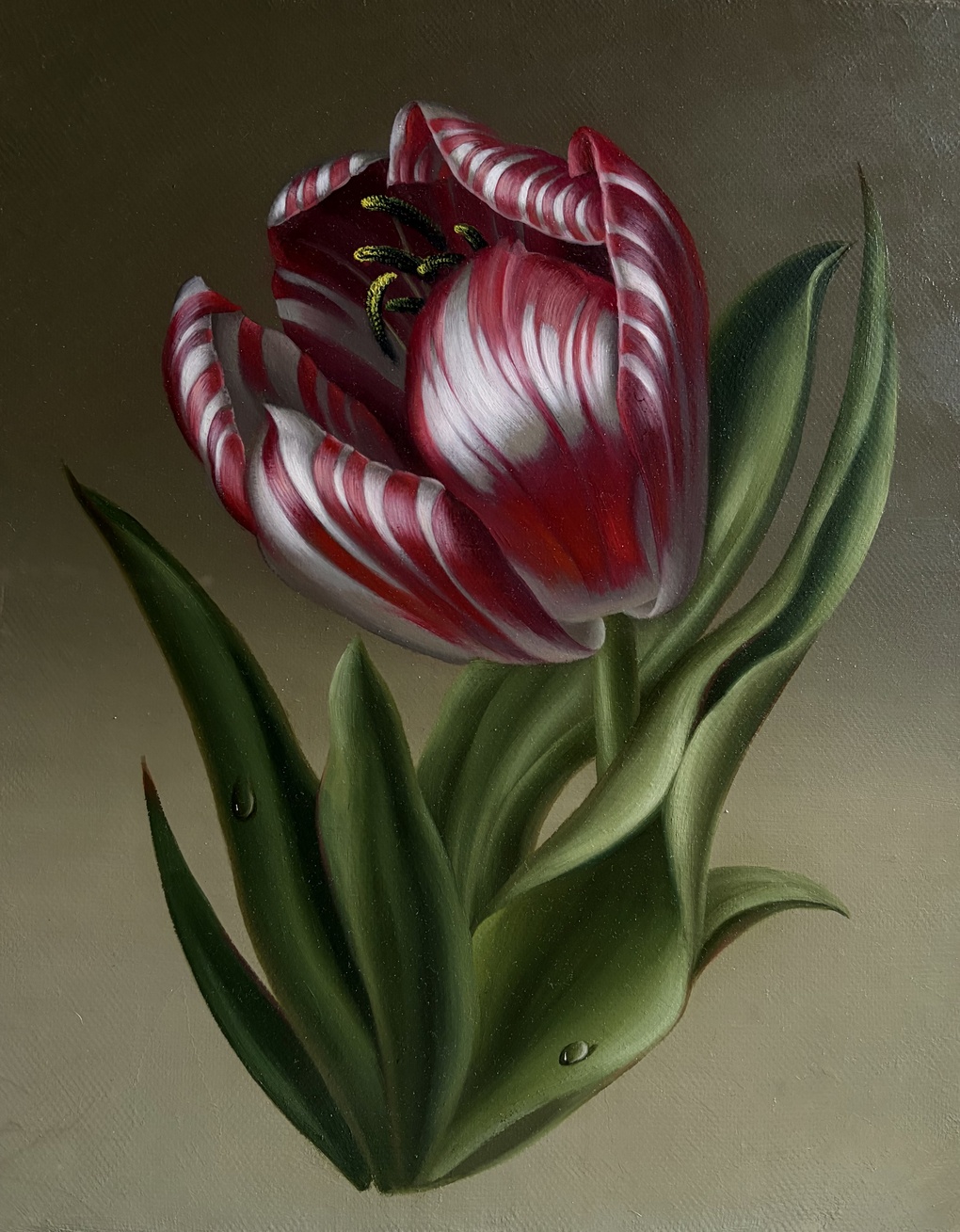
Striped Tulip
Farida KapshanovaThis is a picturesque still life painted in a realistic style. The central image is a variegated tulip: deep red‑burgundy tones contrast strikingly with winding white stripes, highlighting the flower’s natural decorative quality. The details are meticulously rendered: the expressive curves of the petals, the texture of the green foliage, and the transparent dewdrops — they give the composition a sense of freshness and the fragility of the moment. The restrained neutral background and soft chiaroscuro enhance the volume and focus attention on the main subject, evoking the traditions of classic European floral still lifes.
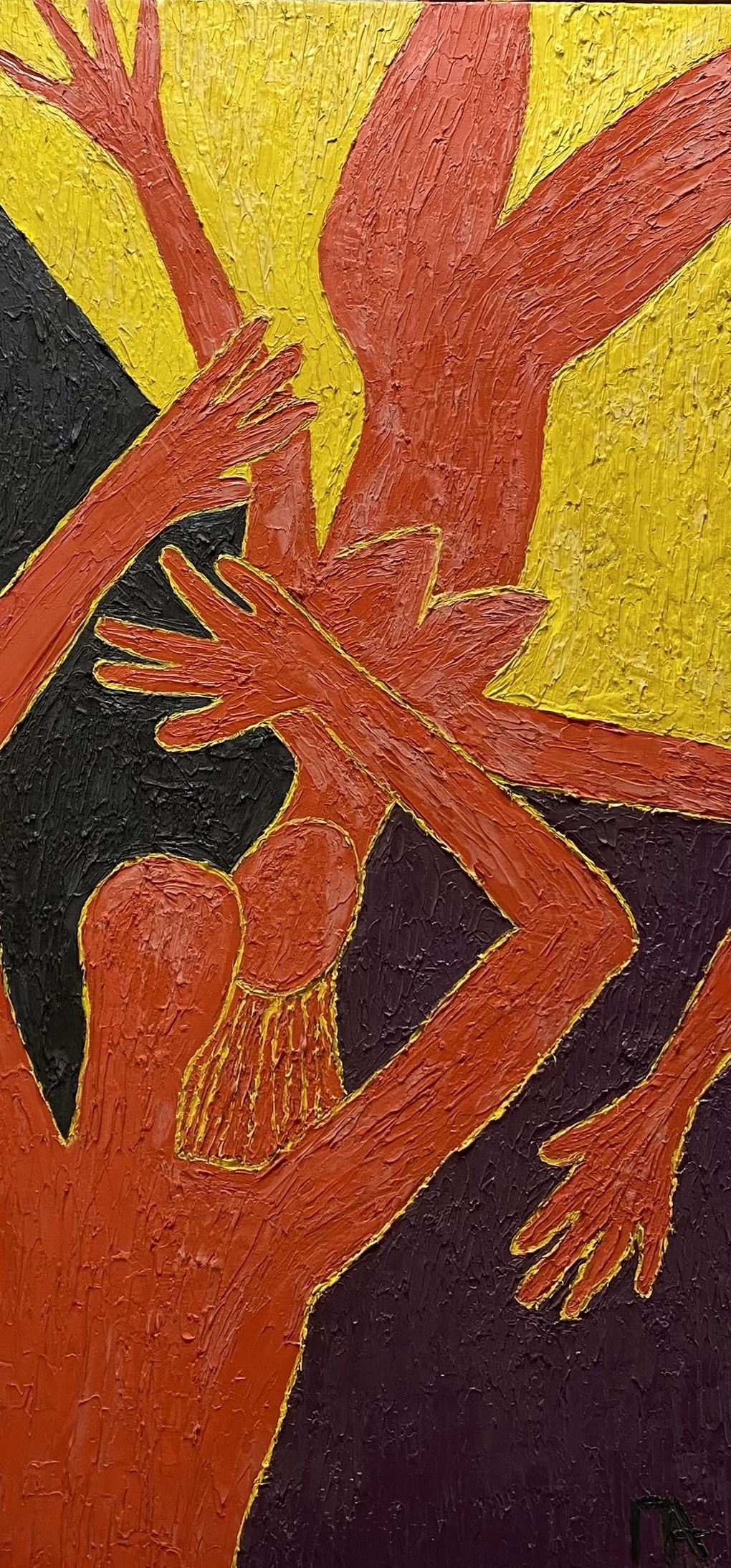
To the bottom
Alina PaylozyanWe are looking at an expressive figurative composition. At the center of the canvas are stylized figures intertwined in a whirling motion: their elongated, almost fluid forms and raised arms create the impression of a ritual dance. The images are deliberately depersonalized: the artist avoids detailing faces and anatomical precision in order to shift the focus to the primal energy of the gesture and the collective experience. The color scheme is built on contrast: the dominant terracotta‑red hue of the figures is perceived as a metaphor for fire, vitality, and passion. It is accentuated by the bright yellow background—it evokes the image of the sun and intensifies the sense of heat. The deep black and dark purple areas function as shadows and pauses, giving the composition rhythm and volume. The texture of the canvas is relief : thick, impasto brushstrokes emphasize the materiality of the paint and add a tactile quality to the work. The contours of the figures are outlined with a thin yellow line—this technique visually “illuminates” the silhouettes and holds them in a taut balance with the background. The conceptual layer of the painting balances between the archaic and the contemporary: the composition recalls rock paintings of dancing people, yet its dynamism and bold use of color are entirely modern.
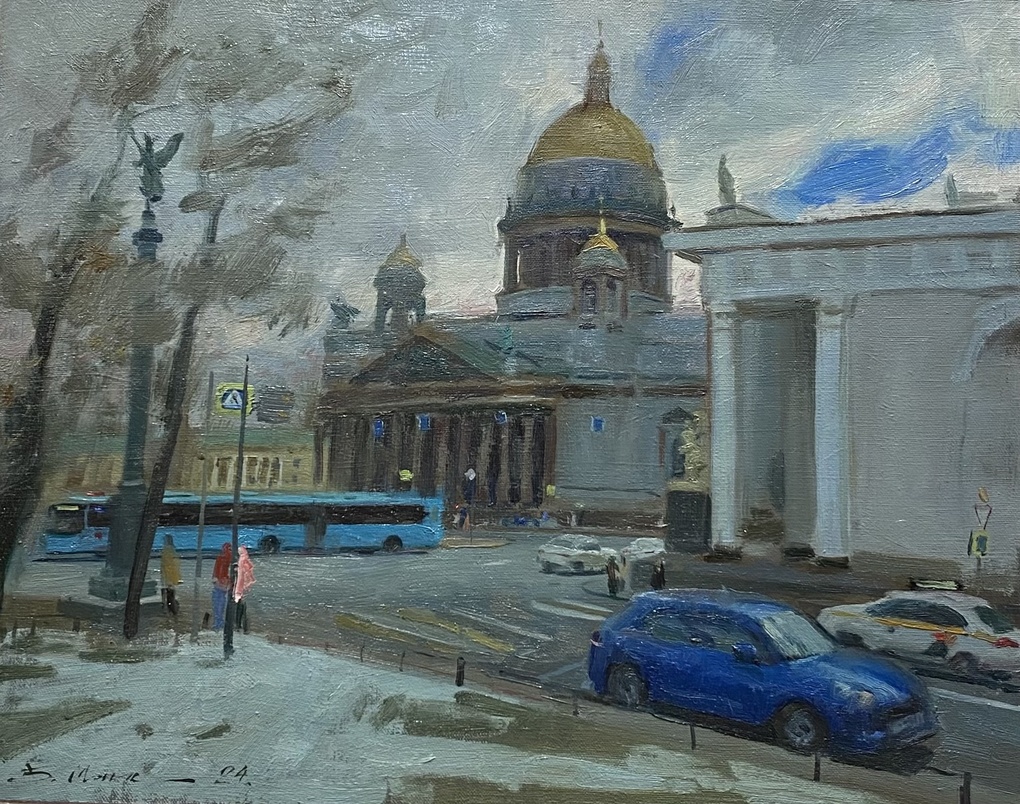
Saint-Isaac’s Cathedral
Munkh BinderyaThis is an urban landscape rendered in an impressionistic manner: the artist captures a fleeting moment of winter in St. Petersburg. The dominant element of the composition is St. Isaac’s Cathedral — its massive silhouette and gleaming golden dome set a monumental tone, while the detailed depiction of the colonnades and smaller domes emphasises the classical rigour of the architecture. The contrast between the centuries‑old architecture and modern details (a blue passenger car, a city bus, road signs) creates a dialogue between eras and lends the canvas a documentary vividness. The colour scheme is restrained, built on grey‑blue and ashen shades, through which local colour accents break through — the gold of the dome, the deep blue of the car body, and the ochre tones of the facades. Textured, loose brushstrokes enhance the sense of frosty air and the dynamism of the urban environment, echoing the traditions of the Russian landscape school of the late 19th — early 20th century.
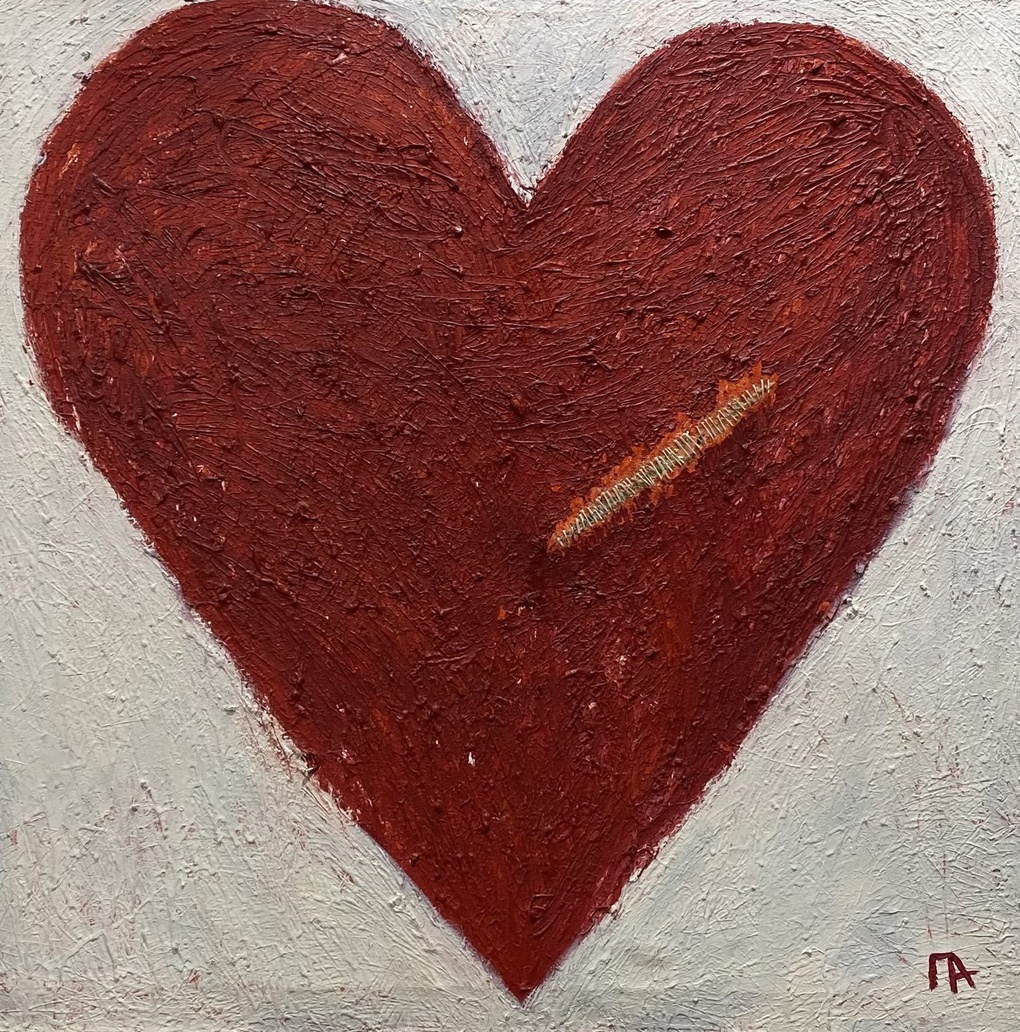
The Conflict
Alina PaylozyanThe painting The Conflict by Alina Paloyzyan is concise yet emotionally charged, with its meaning emerging from the contrast between form and detail. The central focus is a large heart in a deep, rich red hue — its colour balances between passion and unease. The texture is expressive: thick, raised brushstrokes create a sense of tension, as if the surface resists a smooth, effortless reading. The heart’s outline is clear but not perfect; its silhouette carries a raw, slightly uneven energy. The background is a calm, light grey with a grainy texture; it doesn’t distract but rather accentuates the drama of the main image. On the right side of the heart is a thin diagonal line, blending ochre, yellow‑green, and barely perceptible white strokes. This detail looks like a crack, a seam, or a healing scar — and it’s precisely this element that reveals the title The Conflict: it conveys both a fracture and an attempt at reconciliation. In the bottom right corner is the artist’s discreet monogram: a subtle accent that doesn’t disrupt the overall composition. Overall, the work is built on a paradox: the universal symbol of love here becomes a field of inner tension — and the viewer decides for themselves what is stronger in this heart: the wound or the desire to heal it.
Love
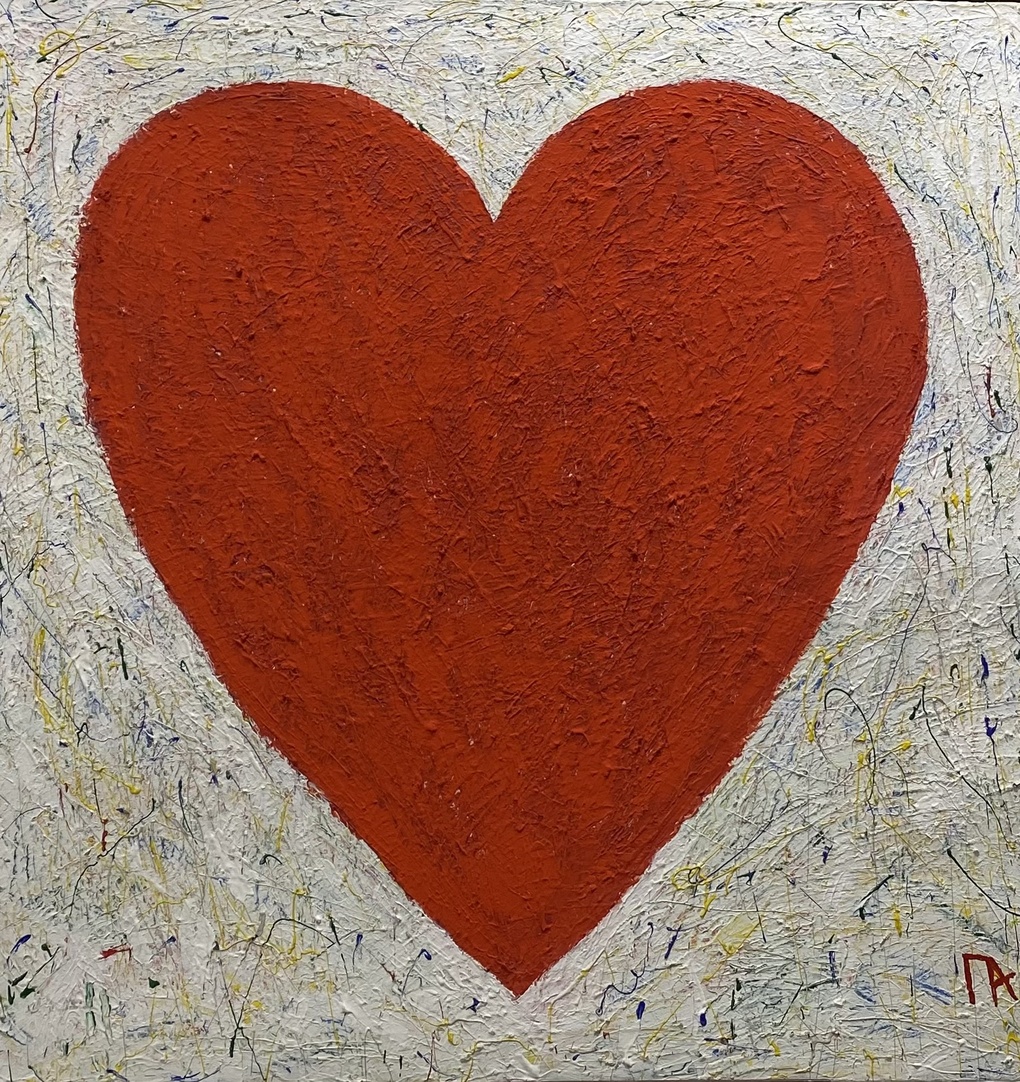
Alina PaylozyanAlina Paloyzyan’s painting “Love” immediately draws the eye thanks to its striking contrast: in the center of the canvas is a large red heart that occupies almost the entire space and becomes the undeniable focal point. Its shape is simple and recognizable, yet it doesn’t look schematic—the soft, slightly uneven curves give the silhouette a sense of liveliness, as if it were drawn not with a ruler but from an inner feeling. The red color alludes to traditional notions of passion and the power of emotion, but the shade is not garish; it’s rich and deep, which lends the image weight and even a certain monumentality. Texture plays a special role in the work: the heart is painted with thick, impasto strokes—the relief of the paint makes it almost tangible, creating an effect of volume and material density. In contrast to this “solid,” weighty center, the background appears light and dynamic: across the light, almost white surface are scattered thin, chaotic strokes and small colored specks—yellow, blue, and black lines seem to capture fleeting impulses, the inner movement of space. This contrast in textures reinforces the main idea: love is a stable center around which life pulsates. Stylistically, the work balances between figurative art and abstraction: an extremely simple symbol is presented without everyday details, yet with powerful expression. In the choice of color, the freedom of the brushstroke, and the deliberate juxtaposition of textures, one can see echoes of Expressionism and Fauvism—movements where the emotional message matters more than literal precision. At the same time, the painting isn’t overloaded with references; it speaks directly and concisely. The title “Love” leaves no room for ambiguity and simultaneously makes the image universal—every viewer can imbue this simple symbol with their own personal meaning.
Hunting Dogs at the Water’s Edge
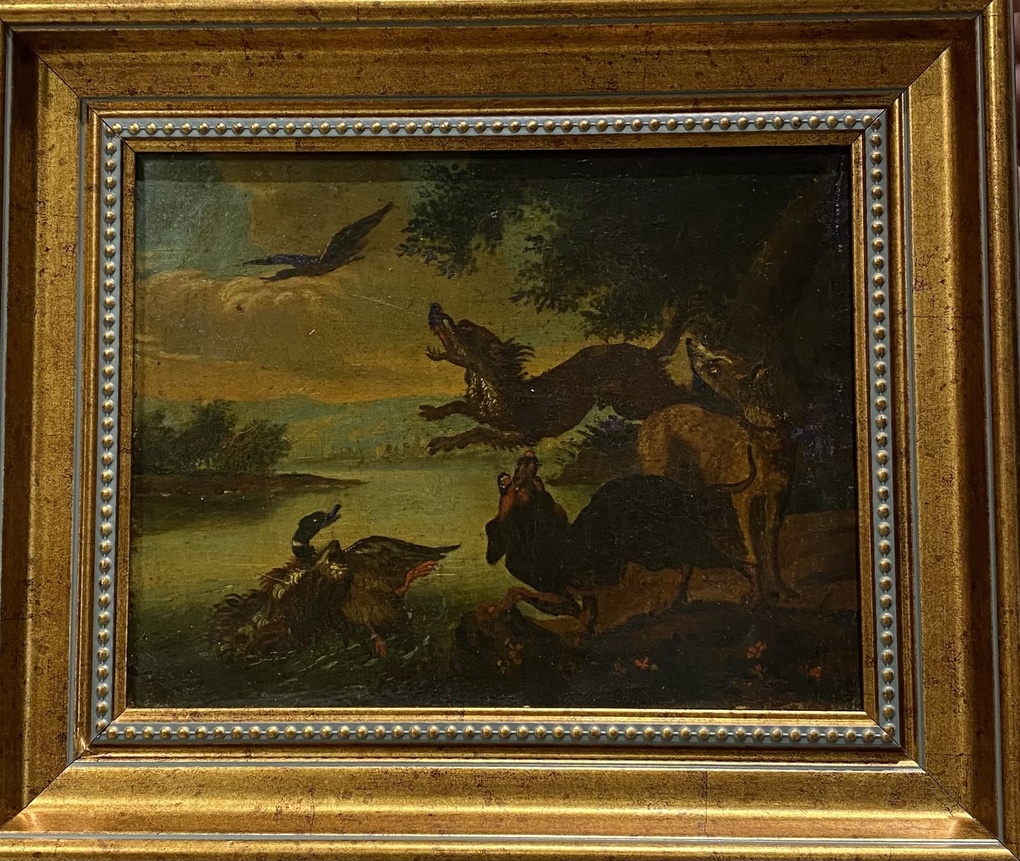
Unknown ArtistThe painting captures a dramatic moment: in the foreground, there is game (including waterfowl with meticulously rendered plumage); a little further back, massive figures of large animals are depicted, their poses conveying tension and dynamism. In the right part of the canvas, the silhouette of a dog is discernible — the constant companion of aristocratic hunting. The background features a tranquil landscape: a smooth expanse of water, gently sloping banks, a dense mass of dark trees, and a dramatic sky with swirling clouds. The warm ochre and olive tones of the land and water contrast with the deep, dark silhouettes of the animals and birds, while the light softly models the volume, emphasizing the texture of fur and feathers. The composition is built along diagonals — they imbue the scene with movement and guide the viewer’s gaze, leading it sequentially from the foreground to the background. The painting combines decorative expressiveness with naturalistic precision: the artist masterfully renders a variety of surfaces — from velvety fur to glossy feathers — and creates an image that is both ceremonial and emotionally charged. Dutch school, around 1700.
Ruins Above the River
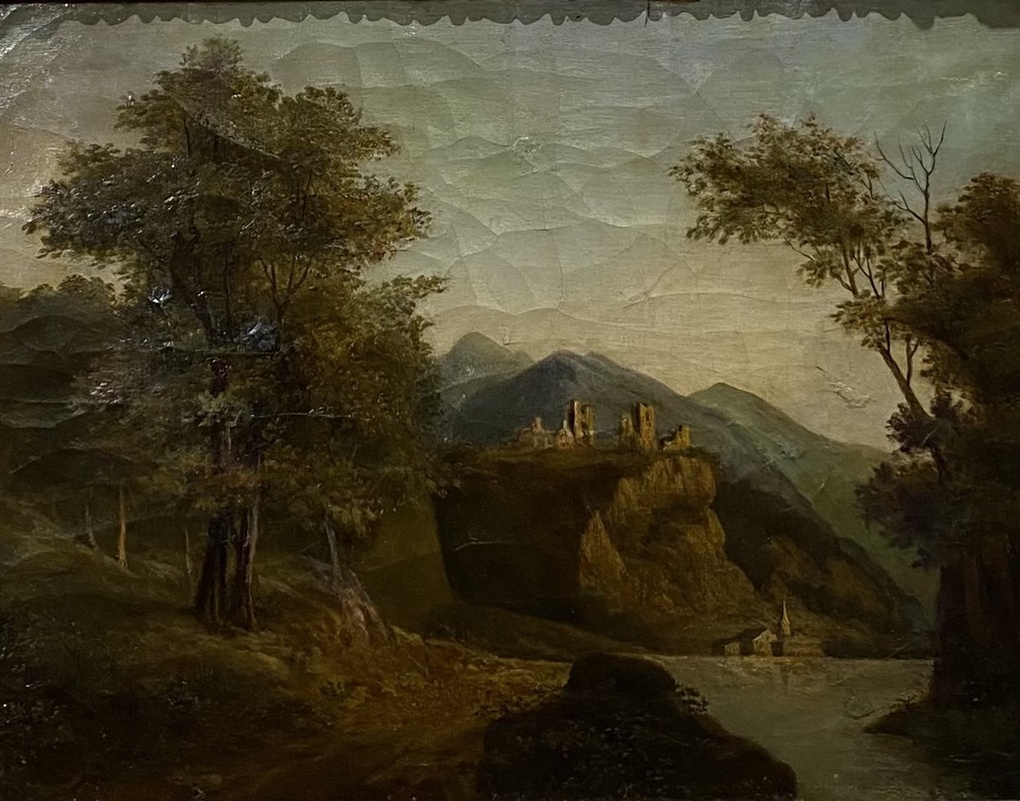
Unknown ArtistThis mountain landscape centers on a rocky promontory crowned by ruined towers above a quiet river. Receding blue-green ridges build a layered distance, while trees at either side form a dark theatrical frame. On the left, stout trunks and dense foliage contrast with the open, softly lit sky. A small waterside structure and slender spire are visible beneath the cliff, establishing the scale of the rocky mass. Earthy olive, brown, and gray-green passages unite foreground, ruins, and distance. The composition draws on the Romantic landscape motif of solitary ruins within imposing nature. A pronounced network of craquelure traverses the painted surface. Highlights on the towers and distant slopes carry the eye from shaded shore to river. French school, 19th century.
Bird with a Sky Capsule
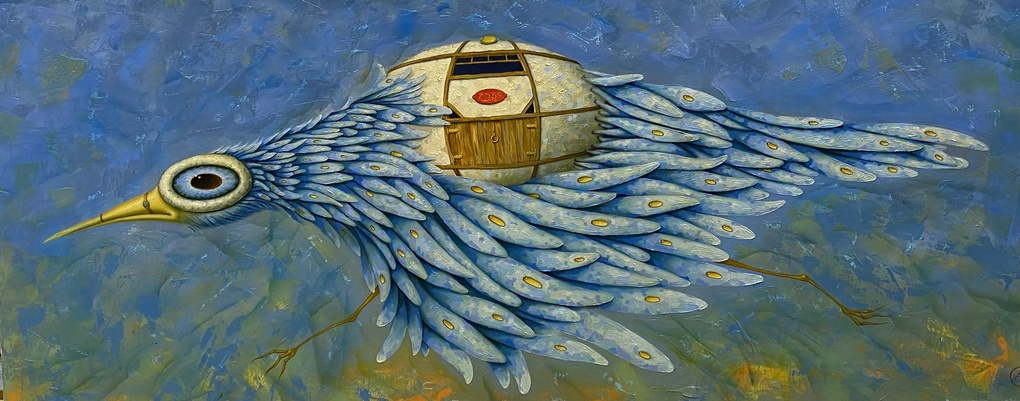
Alexei YezhovA fantastic bird is shown in profile against a dense, textured field of blue, green, and ochre brushwork. Its elongated yellow beak and circular eye with a black center lend the silhouette an instrument-like precision. The plumage is built from dozens of overlapping silvery-blue feathers; each carries a small golden oval, establishing a rhythm akin to rivets or dials. A rounded capsule rests on the bird’s back: an ochre door, dark rectangular window, red oval medallion, and fine borders evoke a miniature flying craft. Slender legs barely touch the composition’s lower edge. The wings’ horizontal spread sustains movement, while the capsule forms a composed central accent. The union of medieval fantasy and mechanical imagery aligns with Alexei Yezhov’s imaginative world.
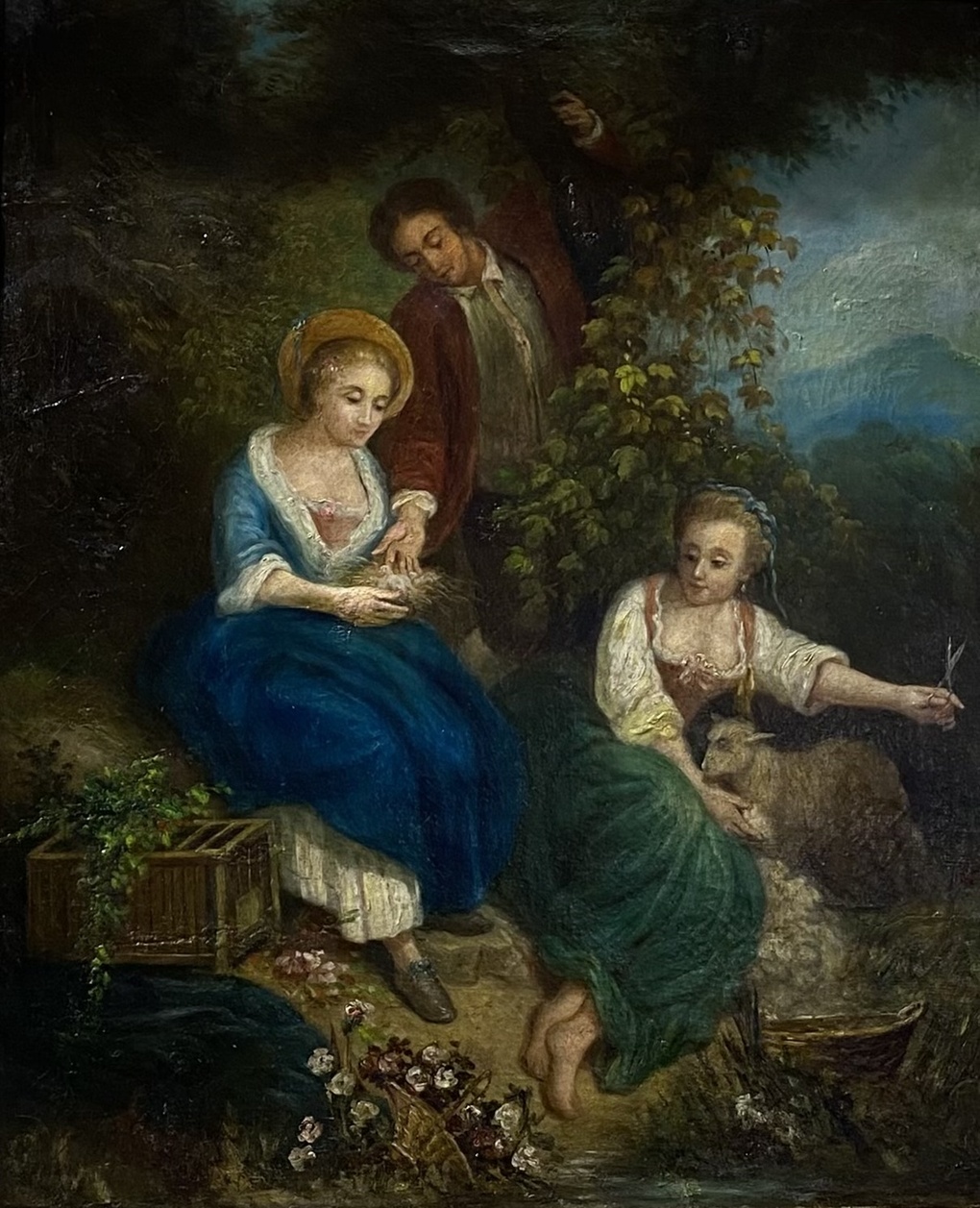
Pastoral with Bird and Sheep
Unknown ArtistThis intimate pastoral scene unfolds beneath a dense canopy beside still water. In the foreground, a woman wearing a blue skirt and ochre hat gently holds a small bird, while a wooden cage rests nearby. A second woman, dressed in a white blouse and green skirt, bends toward a sheep and extends a slender twig. Behind them, a man in a reddish coat leans forward from the foliage's shadow. Flowers, a woven basket, reflective water, and a blue horizon construct an idyllic setting. Soft modeling of faces, drapery, and fleece works against deep shade; saturated blue and green passages anchor the composition. The rounded figural arrangement and filtered golden light evoke the graceful theatricality of Rococo pastoral imagery. French school, 19th century. There are traces of restoration, canvas duplication.
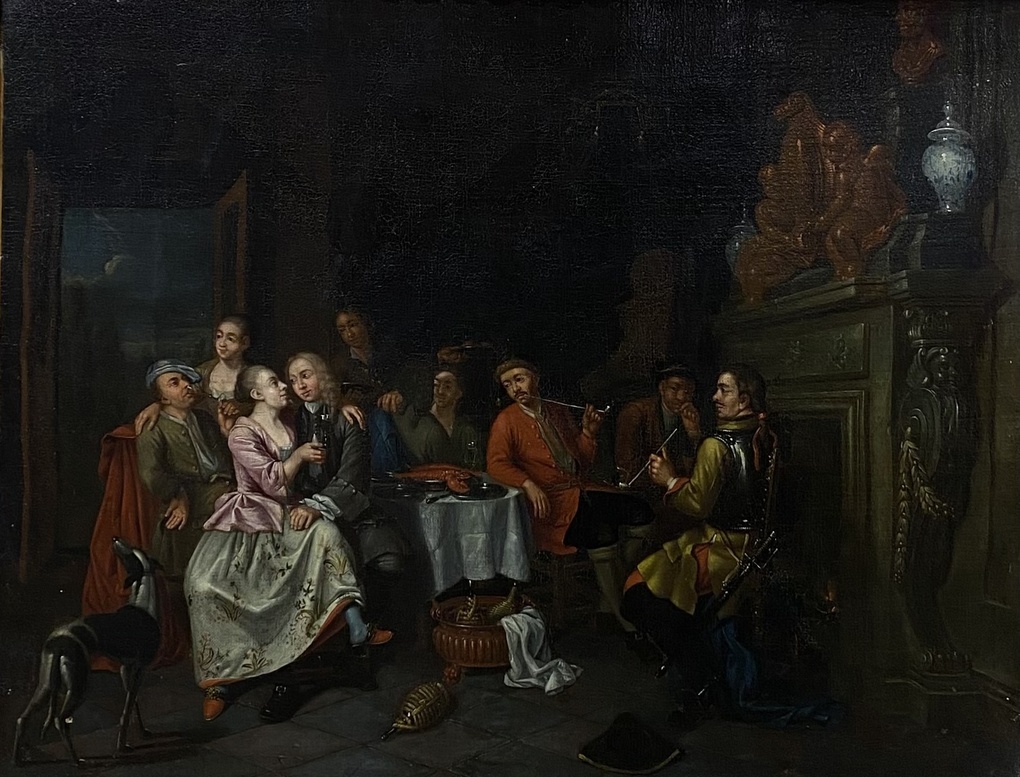
A Galant dinner (Le repas galant)
Balthasar van den BosscheA convivial genre scene unfolds in a dim interior beside a substantial fireplace. Seven men and two women gather around a laid round table, conversing, raising glasses, and smoking long pipes. The central couple is set apart by the cool sheen of a silvery-gray skirt, a pink bodice, and light falling across their faces. At right, a figure in a yellow coat sits before the carved chimney piece, topped with an ornamental group and a pale lidded vessel. Tableware and a red lobster appear on the table, while a basket and white cloth rest below. Deep shadows, localized ochres, and directed illumination create a compact theatrical composition rooted in Baroque genre painting traditions. The contrast between animated faces and the nearly absorbed background intensifies the intimacy of the gathering. The painting depicts a society dinner — a scene from the life of 18th‑century high society, filled with theatricality, hypocrisy, and underlying drama. The composition is rich with characters and details, each carrying a symbolic meaning. The atmosphere is both festive and tense: behind the outward splendour and courtesy lie intrigues, vanity, and moral decay. Expert opinion (expert — V. M. Uspensky); certificate (France) from Guy Herdebo and Alain Latreille, dated May 4, 2001.
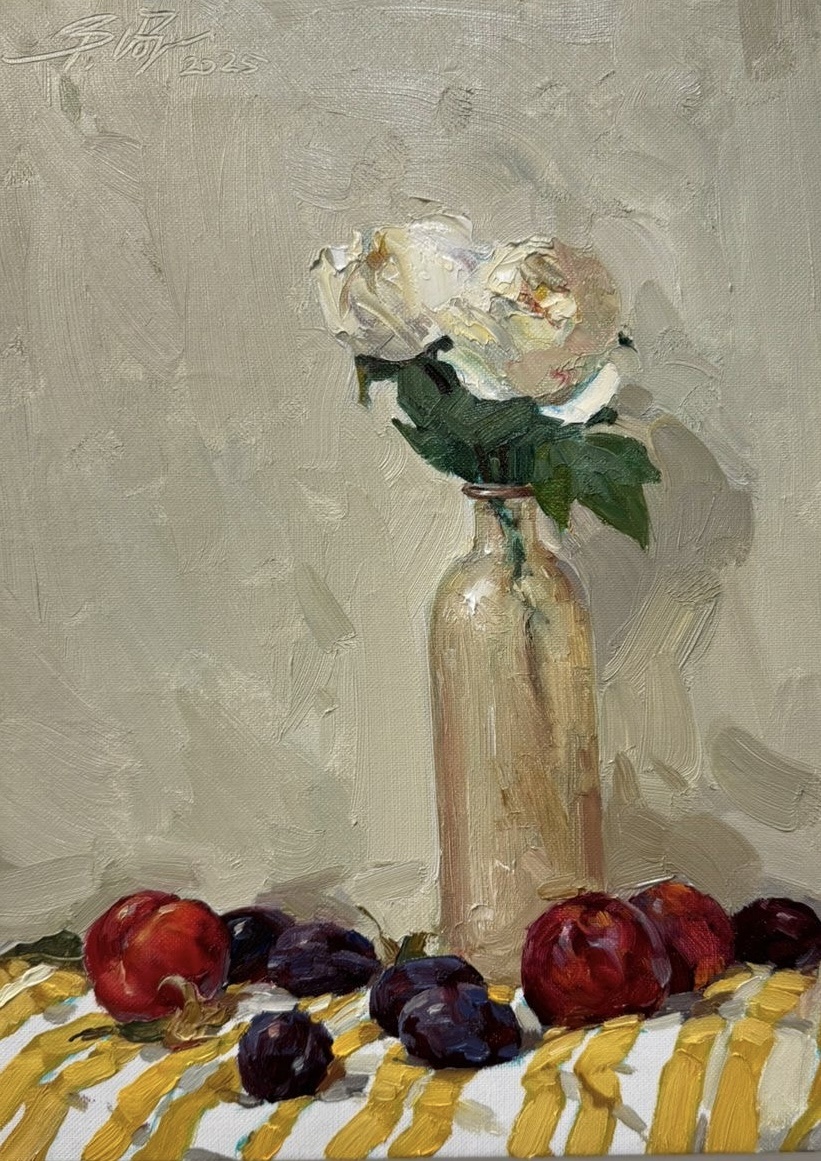
Still Life with White Roses and Plums
Otgoo BadamOtgoo Badam’s still life is a chamber piece in the spirit of Russian Impressionism: a vase with white roses is in the centre, with apples and plums on a yellow‑and‑white tablecloth in the foreground. The composition is balanced: the neutral background accentuates the objects, while impasto brushstrokes give them volume. The palette is restrained — warm yellow stripes contrast with the cool tones of the background, and the rich colours of the fruit and the whiteness of the roses create a harmonious focal point. Badam, a graduate of the Repin Academy, blends academic realism with an expressive painting style.
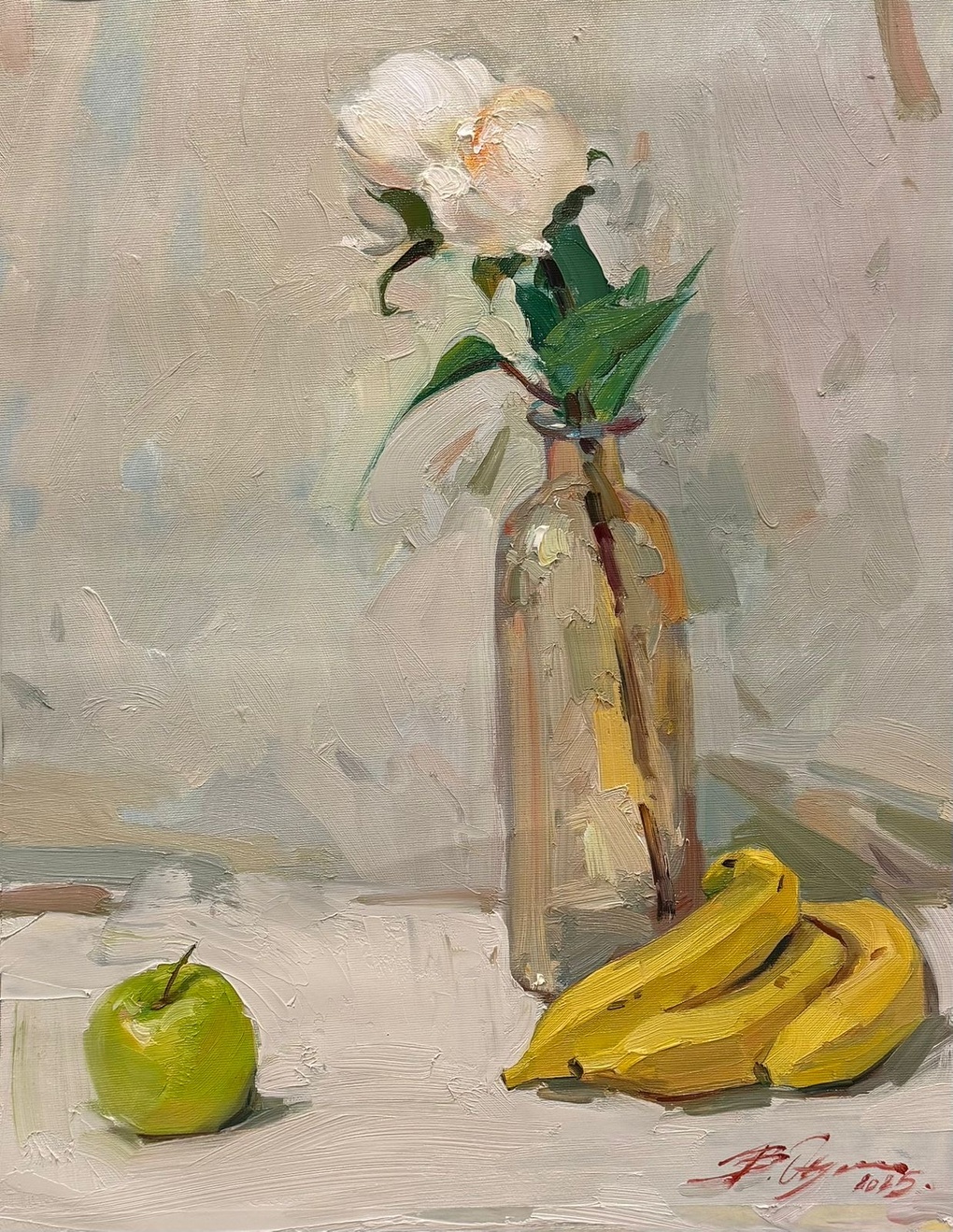
White Rose, Bananas, and Green Apple
Otgoo BadamA concise still life rendered in a soft, restrained palette. At the center of the composition is a transparent glass vase with a single white rose and expressive green leaves; the texture of the glass is accentuated by painterly brushstrokes. To the left is a green apple, to the right a bunch of yellow bananas: their simple, recognizable forms create a calm rhythmic balance. The background is painted in muted gray‑beige tones—it does not distract from the objects but rather emphasizes their materiality. The characteristic dense, impasto technique lends the canvas tangible plasticity and depth. The composition exudes tranquility and contemplation, while the restrained color scheme and expressive texture evoke the traditions of the realist school with elements of impressionistic freedom of brushwork.
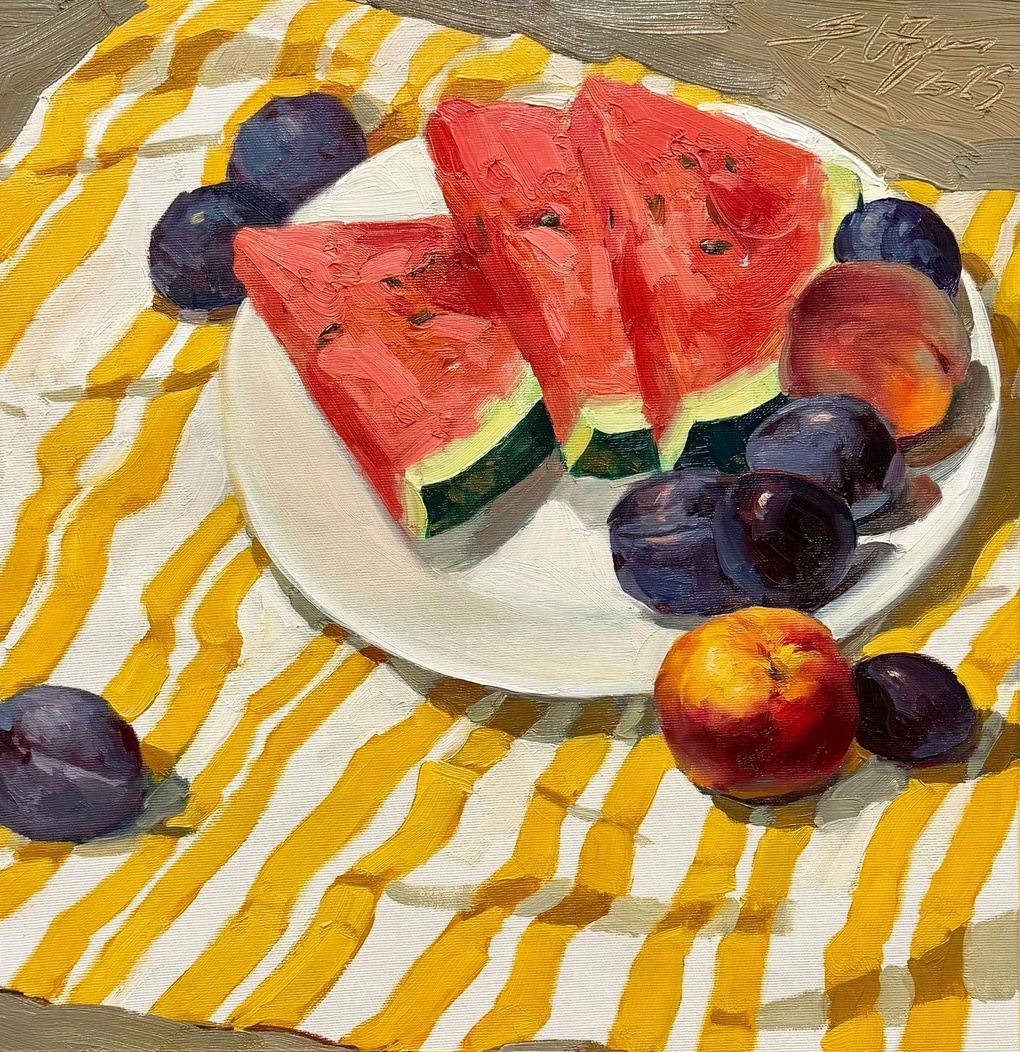
Watermelon and Plums on a Striped Cloth
Otgoo BadamThis still life presents a highly marketable motif of summer abundance: wedges of watermelon on a white plate, flanked by plums and a peach, set against a bold yellow-and-white striped cloth. The artist favors confident, painterly handling with a visibly loaded brush; the tactile red flesh and the cool violet shadows are treated as subjects in their own right rather than as photographic simulation. A disciplined play of warm versus cool, matte versus glinting surfaces, and weighty fruit against the rhythmic movement of fabric folds elevates the domestic scene into a quiet meditation on taste, time, and seasonal brevity. The composition remains direct and decorative—immediately legible in an interior—yet retains the authentic physicality collectors seek in hand-made work. Such intimate fruit still lifes perform consistently well on the private market: they offer immediate color, approachable symbolism of plenitude, and broad placement potential for kitchen, dining, or living spaces, making them a dependable entry point for building a painting collection.
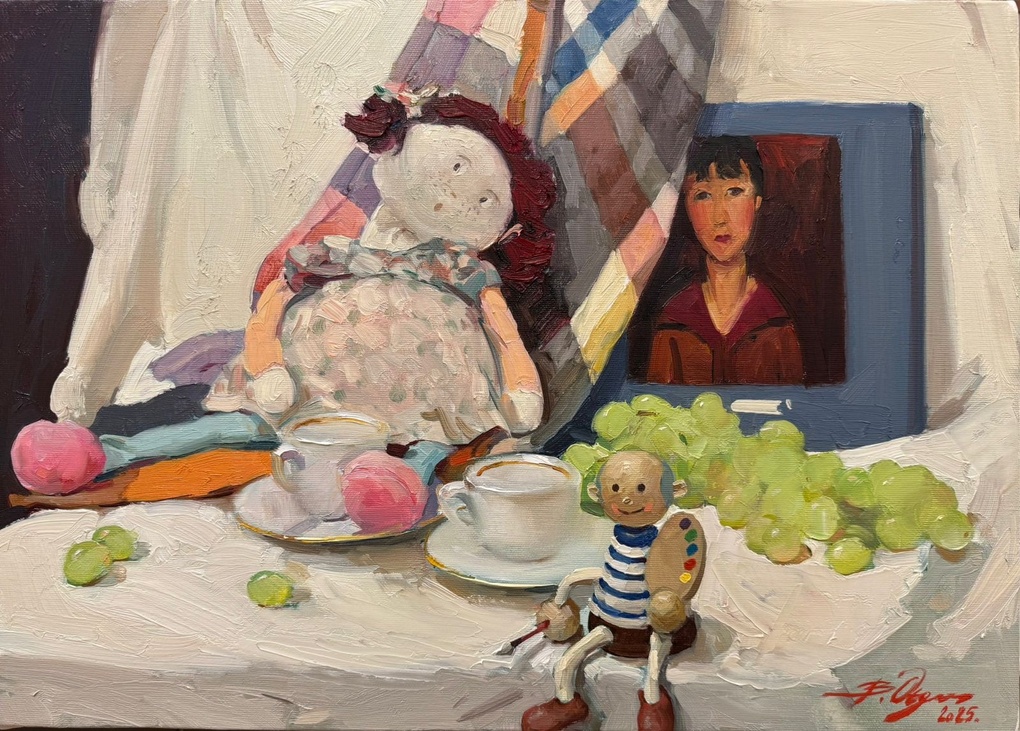
Still Life with Doll and Portrait
Otgoo BadamToys (dolls) are a symbol of childhood, innocence, but also fragility, transience of time. They can remind you of the past, of the lost paradise of childhood. Tea cups are an association with family traditions, the warmth of the home. Grapes are a classic symbol of life, abundance, but also transience (like all fruits, it will soon deteriorate). A child's portrait is a personal, intimate element that turns a still life into a kind of "family history". A doll with a palette is a metaphor for creativity, play, imagination. It can be the image of the artist himself, who "plays" with objects, creating a new reality on the canvas. This work evokes warm, slightly sad feelings associated with memories of childhood, family comfort, transience of time. It is both simple and deep, combining everyday specifics with poetic metaphor. The artist does not just depict objects, but creates an atmosphere, invites the viewer to reflect on the meaning of things, on the connection between the past and the present.
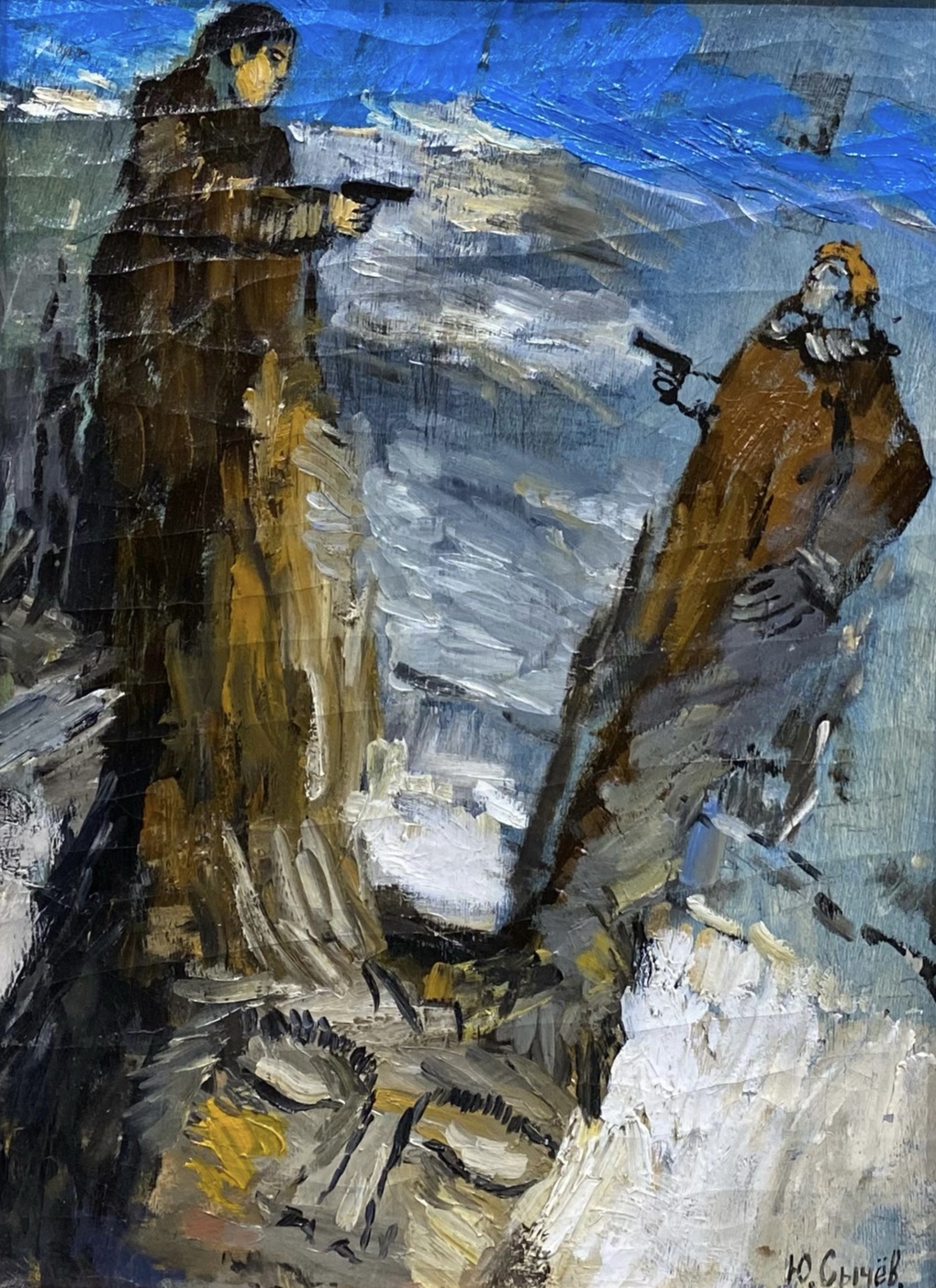
Duel in the Snow
Yuri SychevY. Sychyov’s painting depicts a dramatic confrontation between two figures with pistols, where the figure on the left dominates — standing confidently with an outstretched arm, while the figure on the right appears bewildered and defensive. The composition is built on the contrast between the poses and emotional states of the characters. The colour scheme is restrained: dark brown and black tones of the clothing contrast with the cool blue and grey hues of the background, while yellow accents add tension. The painting style is expressive: broad brushstrokes and impasto create volume, while the background is sketched loosely, focusing the viewer’s attention on the characters. The plot can be interpreted in several ways: as a literary-historical narrative (honour, betrayal), a psychological drama (the struggle between opposites), or a social commentary (a clash of worldviews). The landscape is generalized, creating a sense of замкнутого, closed, hopeless space. The work combines realism and expressionism, conveying the «nerve» of the moment and the inner energy of the conflict, prompting the viewer to reflect on the fine line between aggression and vulnerability.
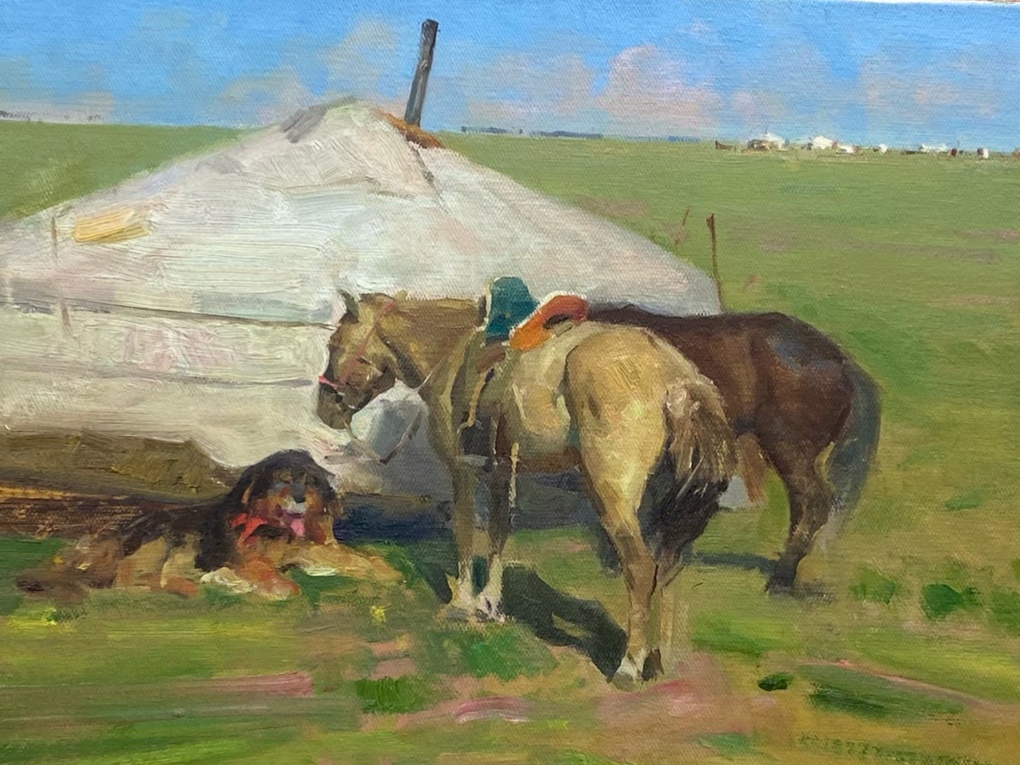
Rest Stop by the Yurt
Munkh BinderyaThe composition is built on a combination of natural elements and everyday objects of nomads. The central object is a yurt — the traditional dwelling of nomads, symbolising the connection between humans and nature, as well as nomadic culture. The composition is asymmetrical: the yurt is positioned on the left, while the main group of animals (a horse and a dog) is shifted towards the foreground. This creates a sense of spontaneity, of a “captured moment” from everyday life. The horizontal line of the horizon emphasises the vastness of the steppe landscape, while diagonal lines (the horse’s back, the dog’s posture) add dynamism. This scene embodies the idyll of nomadic life: the harmony between humans, animals and nature. The horse is a key companion of the nomad, a symbol of freedom and strength. The dog fulfills a protective role, highlighting the coziness of home. The yurt represents mobility and adaptation to the harsh conditions of the steppe. The brushstrokes are loose and impressionistic, with a clear texture. The artist does not aim for photorealism, but rather conveys the general mood of the scene. Glazes (transparent layers of paint) create a sense of the slight shimmer of air typical of the steppe climate. The painting evokes a feeling of tranquillity and gentle nostalgia. The vastness of the steppe, the calmness of the animals, and the stillness of the yurt create a sense of the eternal cycle of life and harmony with nature. Warm hues and soft light emphasise the benevolence and sense of security in this world.
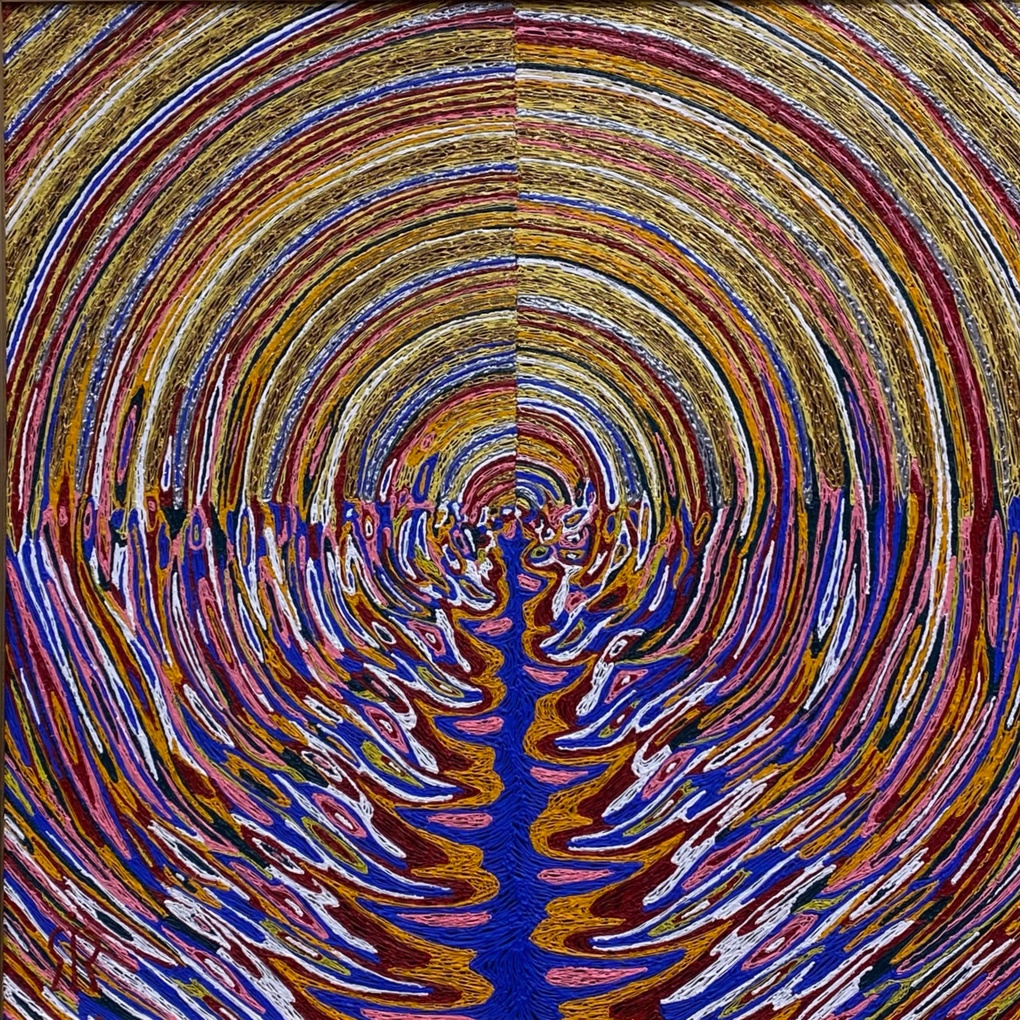
Dawn
Igor RyazantsevIgor Ryazantsev’s painting Dawn is executed in the filumism technique: acrylic paint is extruded with a syringe onto a black‑primed canvas in the form of thin threads, forming a relief image with the effect of an acrylic tapestry. Through the interweaving of threads, the artist embodies his key idea of the interconnectedness of all things — the threads symbolise invisible links between people, events, past and future. Vivid shades of yellow, red and лазуритовый (lazurite/azure) convey the atmosphere of morning light breaking through the darkness, while the black background enhances the expressiveness of the colour threads. The relief surface gives the work a tactile appeal and creates a sense of movement: layers of paint form a dynamic composition, visualising the transition from darkness to light, from chaos to order.
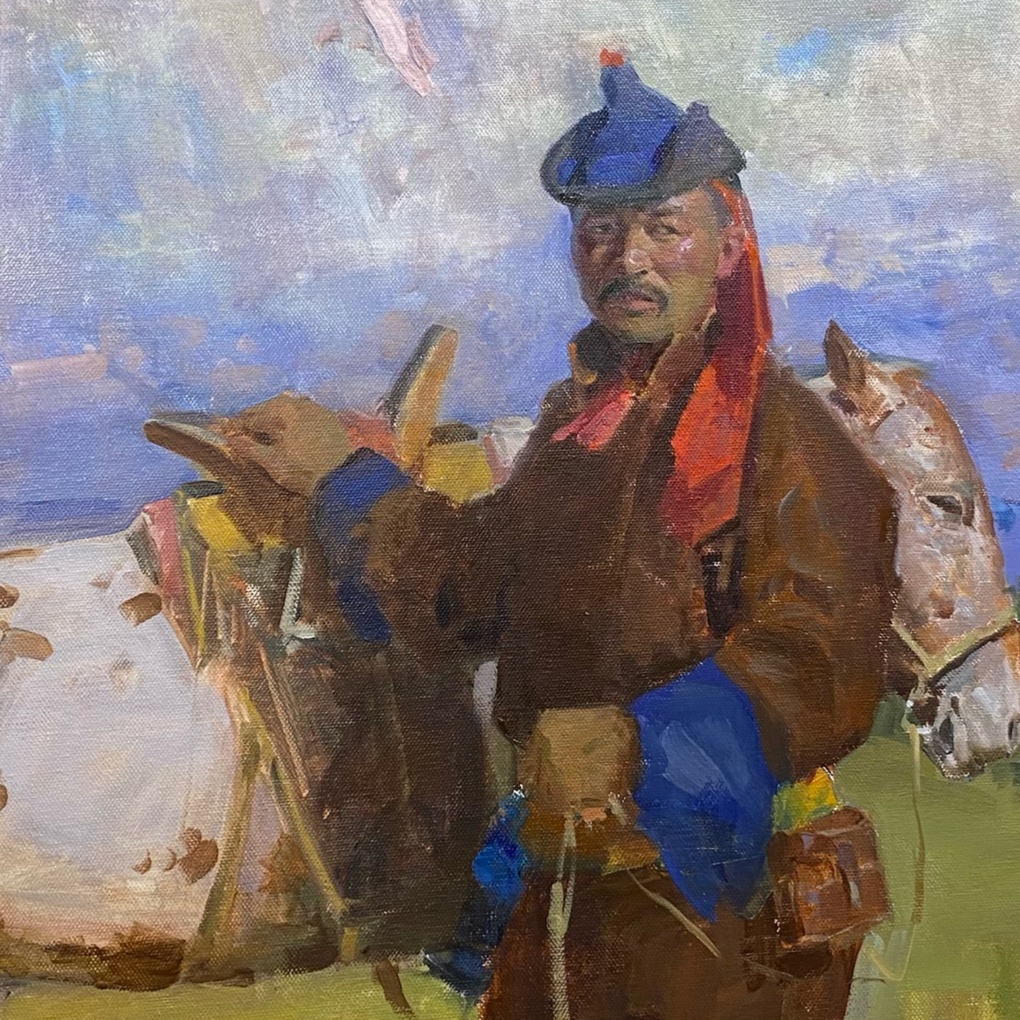
Rider in a Blue Cap
Munkh BinderyaThis is a portrait of the ethnographic genre. The central figure is a man in traditional Buryat clothing, depicted against the backdrop of a steppe landscape with a horse. The composition is structured with an emphasis on the human figure, which occupies the foreground and draws the viewer’s primary attention. The horse, positioned slightly behind, complements the image, underscoring the hero’s connection to nomadic culture. The painting is executed in a warm yet restrained colour scheme.
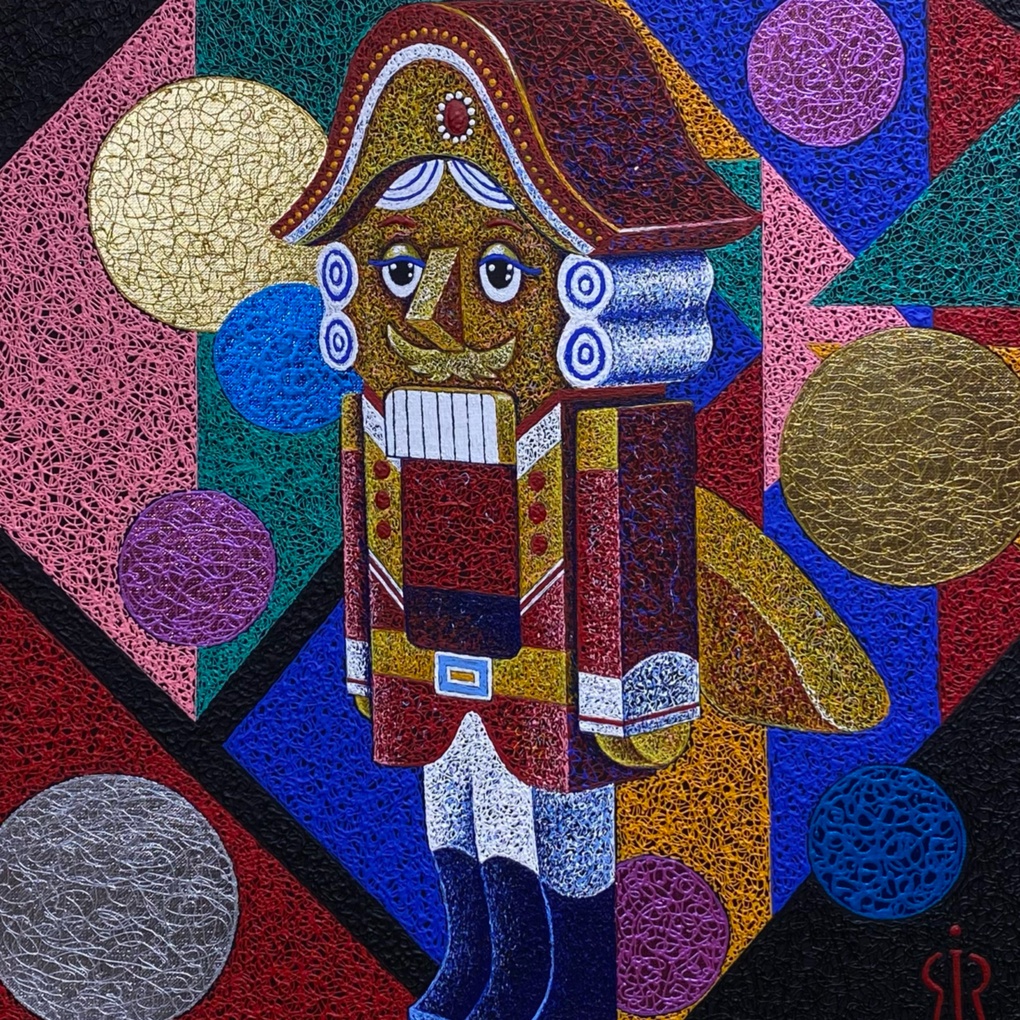
The Nutcracker: Sentinel Dream
Igor RyazantsevIgor Ryazantsev’s painting The Nutcracker is a pictorial interpretation of E. T. A. Hoffmann’s famous tale and P. I. Tchaikovsky’s ballet, likely executed in oil or acrylic on canvas in a vertical format. The central focus of the composition is the transformation of the Nutcracker from a wooden toy into a noble prince, with young Marie standing beside him, frozen in admiration. The composition follows a diagonal structure: the viewer’s gaze moves from Marie in the lower left corner to the Nutcracker in the upper right, creating an upward movement that symbolises spiritual elevation. The colour scheme is based on a contrast between warm golden‑red hues (Christmas tree lights, Marie’s dress) and cool blue‑violet tones (the Nutcracker’s cloak, the background), while shimmering highlights and a light halo around the Nutcracker enhance the sense of magic. The painting technique combines smooth brushstrokes in depicting fabrics and hair with more textured, relief‑like strokes in rendering details, and the interplay of light and shadow adds dramatic tension. Through symbolic elements — the Christmas tree as an image of Christmas miracle, the faint outlines of the mouse army in the background, and a nutshell at the characters’ feet — Ryazantsev conveys the idea of transformation: faith in wonder and purity of heart have the power to change the world. The work resonates with the traditions of “fairy‑tale painting” by Russian masters such as Viktor Vasnetsov and Mikhail Vrubel, yet it is given a contemporary interpretation: it is not merely an illustration, but a reflection on the magic of childhood and the power of imagination.
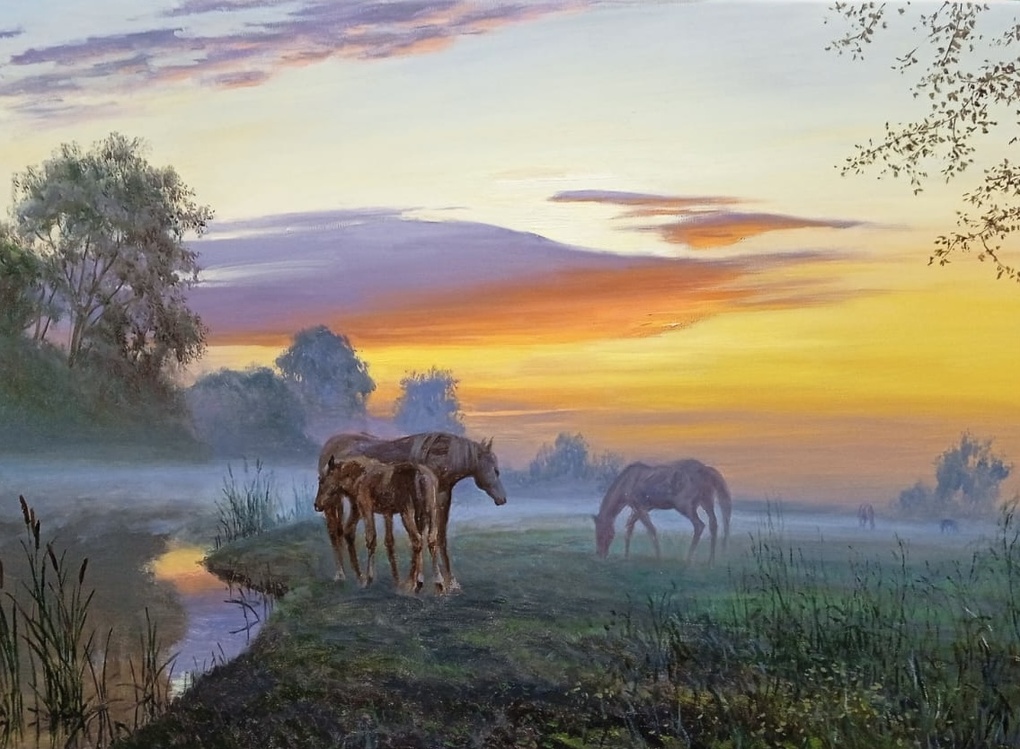
Misty Dawn in the Meadow
Dmitry KrasnovThis is a picturesque painting in the landscape genre with elements of animalism: in the foreground, there are three horses peacefully grazing in a meadow by the water’s edge, while the backdrop features a mesmerising sunset that has painted the sky in warm shades of orange, yellow and pink, gradually transitioning into cool violet and blue tones. The composition follows the classical principle of balance: the foreground is occupied by the group of horses, the middle ground — by the soft outlines of trees and a misty haze, and the background — by the dominant sunset sky, which takes up a significant portion of the canvas. The horizontal horizon line clearly separates the earth and the sky, emphasising the vastness of nature. The artist skilfully uses the contrast between warm and cool tones: the rich hues of the sunset sky create a sense of soft glow typical of the evening, while the muted greens and browns of the land and vegetation emphasise the naturalness of the scene. The misty haze connecting the foreground and background softens the transitions between colours and adds atmosphere. The horses, positioned asymmetrically, add dynamism to the composition without disrupting the overall sense of harmony. Their figures do not overwhelm the painting but are organically integrated into the natural landscape. The animals here are not merely subjects of depiction but a symbol of freedom, strength and natural grace. They embody the connection between humans and nature, calmness and harmony, as well as the cyclical nature of life — after all, the sunset symbolises the end of the day, peace and the anticipation of a new beginning. The technique combines realism and elements of impressionism: the blurred outlines of the trees in the background convey aerial perspective, the detailed rendering of the horses and grass in the foreground creates a sense of presence, and the smooth colour transitions in the depiction of the sky and mist lend the work лёгкость and airiness. Free brushstrokes enhance the atmospheric impression of the scene, while the gradations of the sunset sky create a sense of light in motion. The emotional impact of the painting cannot be overstated: it evokes in the viewer a feeling of tranquillity, gentle nostalgia and unity with nature. The soft colours and smooth lines create a meditative atmosphere, prompting reflection on the beauty of simple natural scenes. The work combines the precision of realism, the lyricism of landscape painting and the expressiveness of impressionism, transforming an ordinary sunset landscape with horses into a profound philosophical image filled with calmness and inner harmony.
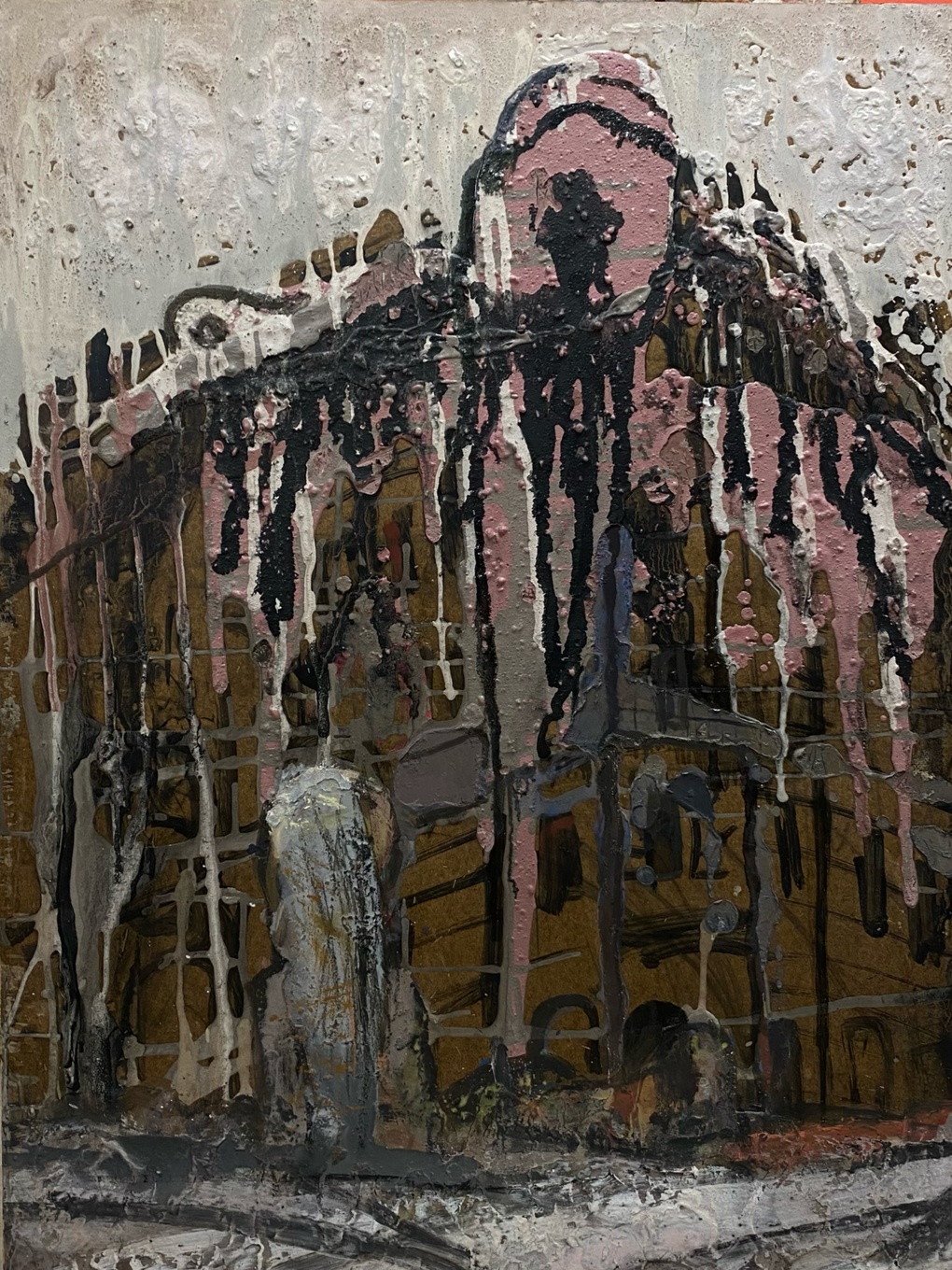
House
Valery LukkaThe work is executed in an expressive manner with elements of abstraction: the artist uses thick paint texture, the “dripping” technique and layering, which creates a sense of dynamics and inner energy. Contrasting colour combinations dominate — pink and black patches against a background of white and brown areas. Pink adds emotionality, black brings drama, and white balances the composition, forming light accents. In the centre of the painting is a massive form resembling a house, while paint flows dripping downwards, enhancing the feeling of movement and instability. The relief texture, with clear traces of brush or palette knife marks, emphasises the materiality of the painting and gives the work volume. The painting evokes mixed emotions — from anxiety and tension due to dark patches and chaotic lines to interest in the internal logic of the composition. It can be interpreted in various ways: as a reflection of inner conflict and the flow of emotions (psychological interpretation); as an image of a building or ruins in the chaos of the modern world (urban interpretation); as a symbol of the struggle between light and darkness, order and chaos, past and present (symbolic interpretation). The painting is executed in the style of “Brutal Expressionism”. Brutal Expressionism is an art movement that combines the characteristic features of Expressionism with special emotional intensity, aggressiveness and physical expressiveness. It focuses on strong, sometimes gloomy emotions, social tension and physical energy, using rough, sharp forms, contrasting colours and a dynamic manner of execution.
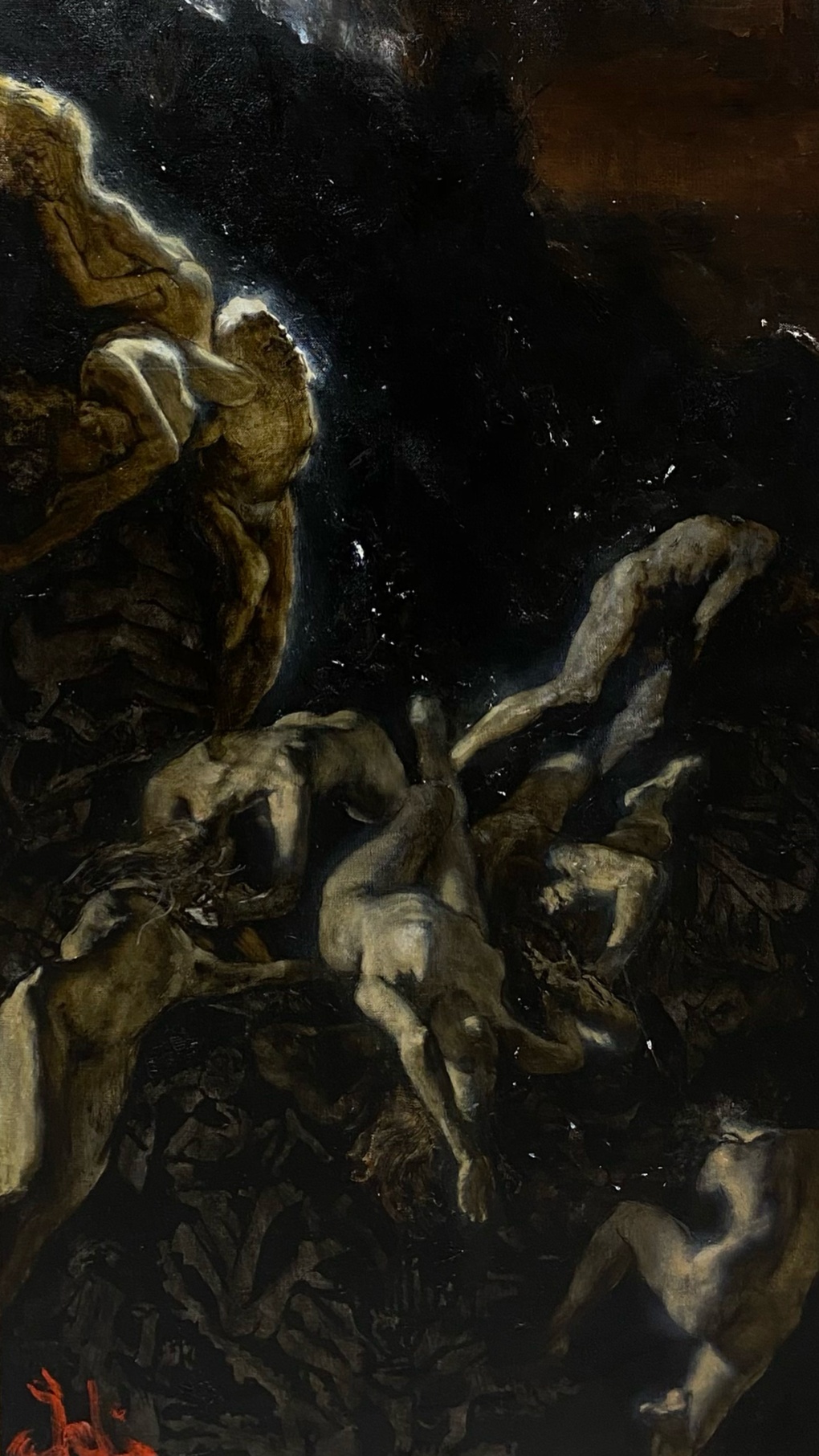
The Fall
Mikhail SolovyovA monumental, night-bound tableau unfolds in near-bottomless darkness: nude, vulnerable bodies appear dislodged from any ground and drawn into a downward vortex. The work is less concerned with academic anatomy than with the dramaturgy of light—cool, intermittent highlights skim shoulders, backs, and limbs, turning the figures into symbols of a shared human condition: loss of control, the collapse of order, and inevitability. Broad handling and selectively dry brushwork sit over dense, deepened layers, creating a surface that hovers between the corporeal and the spectral. The painting resonates with the tragic tradition of European Baroque and the psychological charge of Expressionism, yet its restraint keeps it distinctly contemporary. For collectors, its appeal lies in the rare combination of panoramic narrative and intimate painterly force: it reads as a decisive focal piece, capable of anchoring a room and elevating a collection with high emotional voltage and strong curatorial presence.
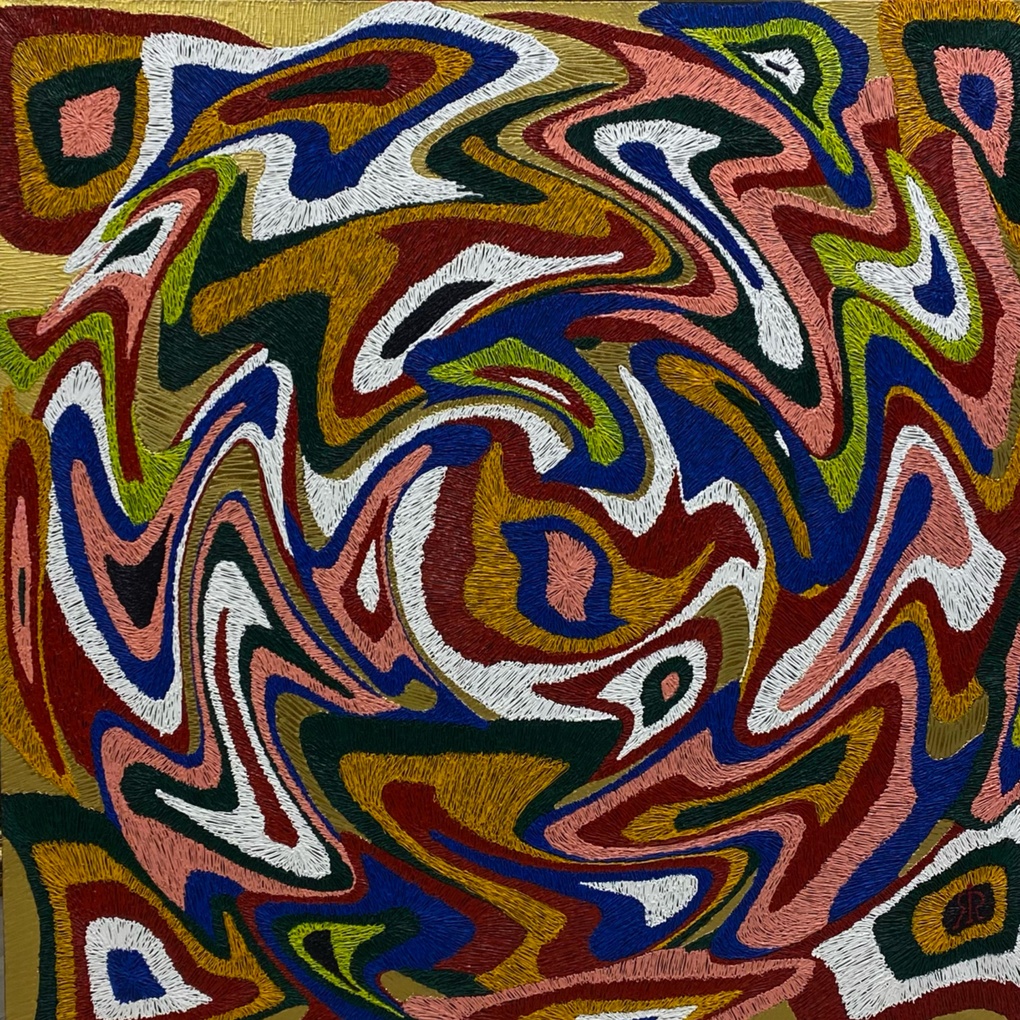
Dream
Igor RyazantsevThe painting captivates with its dynamic movement. At its core is a play of coloured patches that resemble islands — they contract and expand again around a certain centre, creating the impression of a map of sea currents. At first glance, the abstract forms appear similar to cross‑sections of living tissues or fragments of a mosaic. One can discern elements of folk ornaments in them, but it’s important to understand that this is not merely an illustration. The artist skillfully balances between decorative beauty and emotional depth. The distinctive feature of this work lies in its materiality. Thanks to a special technique of applying paint, each stroke resembles embroidery. Here, colour becomes not just an optical effect but a genuine material object. This creates an unusual tactile sensation — something particularly rare in abstract art. The painting’s colour scheme is built on the contrast of rich cobalt, ocher, and terracotta tones with white “slits”. This contrast establishes a special rhythm that is perceived as a pulsation — like a heart beating in tune with the work’s own rhythm. For the discerning collector, this piece represents an outstanding example of abstract art. Its value lies in the impeccable craftsmanship and energetic composition. Such a work retains its relevance regardless of fashion trends. It fits seamlessly both in a modern interior and in an exhibition space dedicated to textile art or painting.
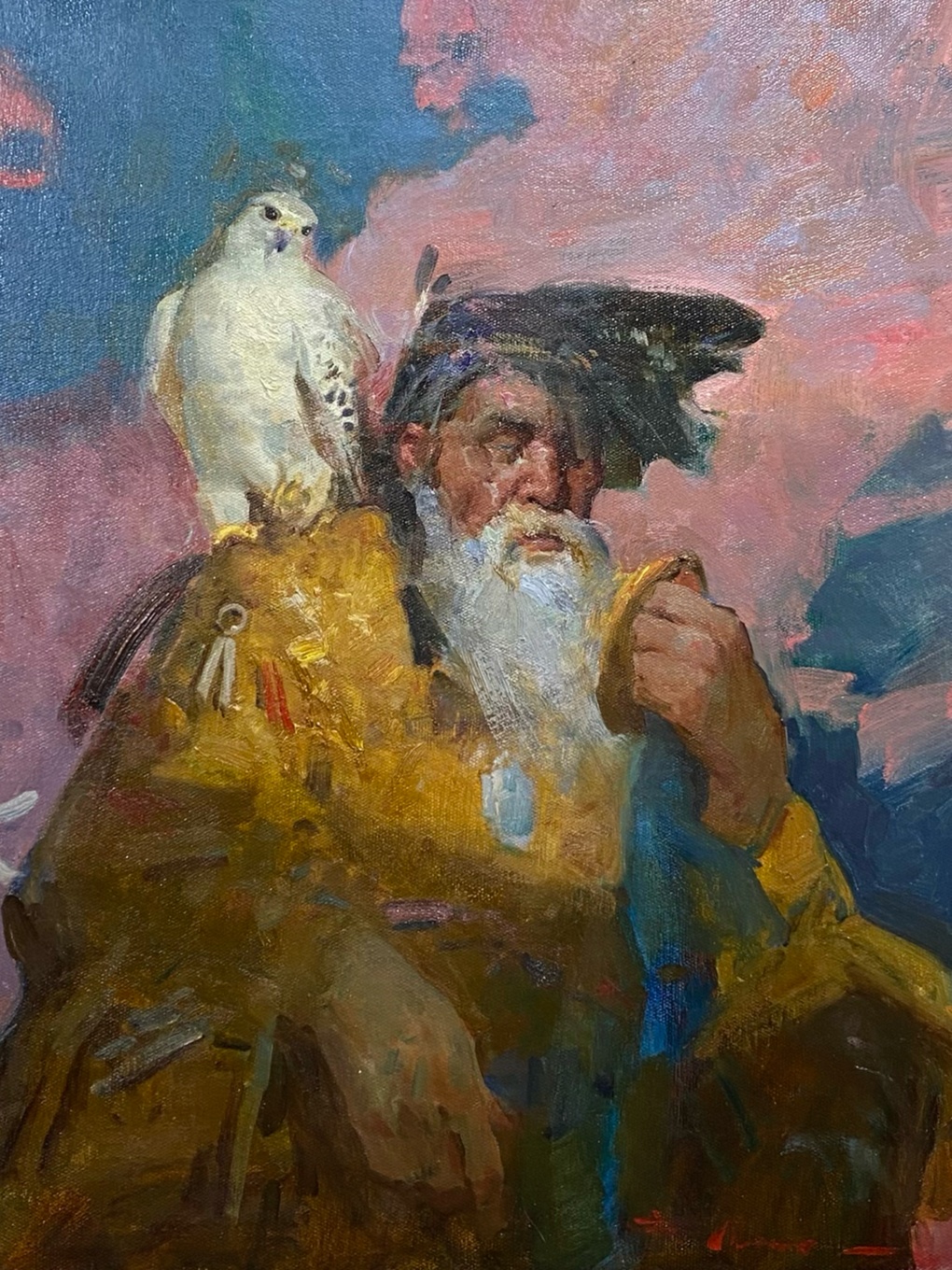
The Falconer
Munkh BinderyaThe painting depicts an elderly man with a long white beard, dressed in traditional ethnic clothing. A white falcon is perched on his shoulder. The composition is based on a close‑up shot. The contrast between the massive, earthy figure of the old man and the light, elevated bird creates dramatic tension. Positioned above the man’s head, the falcon visually “leads” the composition, emphasising its vertical axis. This enhances the sense of connection between man and nature, between the earthly and the heavenly. The artwork is executed in an expressive manner, using thick, textured brushstrokes. The colour scheme is built on the contrast between warm and cool tones. The work resonates with the traditions of Russian epic painting (Surikov, Repin) but is reinterpreted through the lens of the “Severe Style”. It features: monumentality and plastic expressiveness;conciseness of details combined with deep semantic richness; a combination of realism and symbolism.
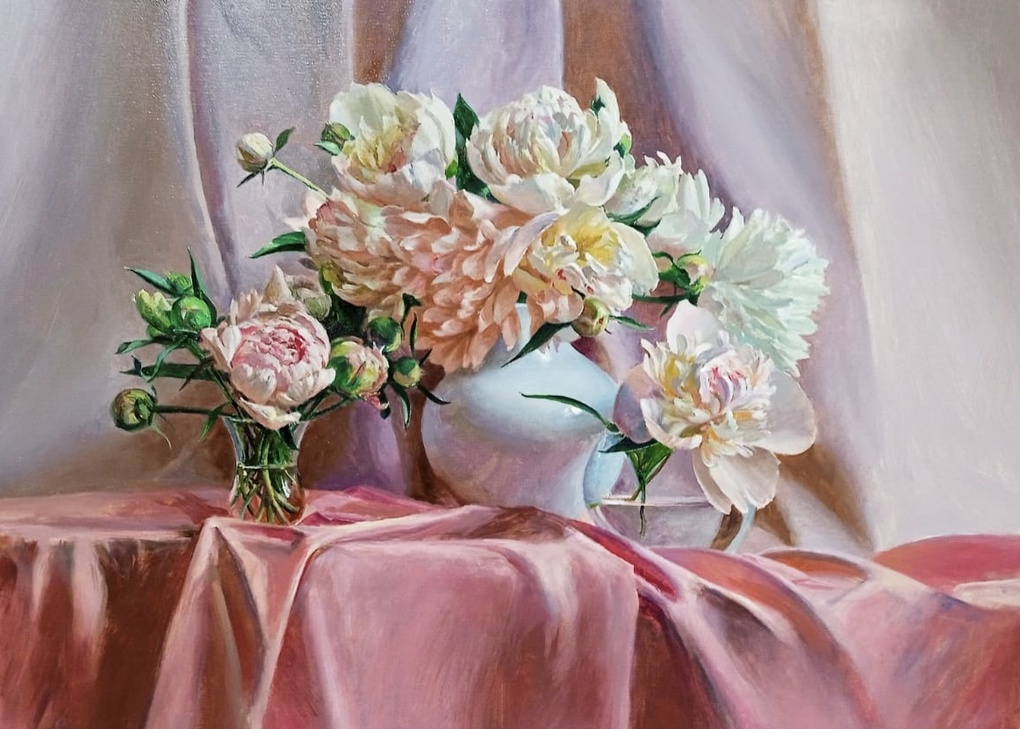
Peonies on Pink Drapery
Dmitry KrasnovThe still life captivates with the harmony of white‑and‑pink peonies and softly shimmering fabrics. Here, the flower is not merely a motif, but a subtle metaphor for the fleeting nature and generosity of the moment. The viewer’s gaze glides smoothly: from the lush, “whipped” texture of the petals to the strict geometry of the ceramic vase, and then to the elegant folds of the tablecloth. In this way, an ordinary scene transforms into an intimate arrangement full of inner meaning. The palette is built on noble pearlescent and powdery hues, delicately enlivened by rare green accents. These touches prevent the composition from becoming overly sweet, lending it freshness and vitality. This work is a true gift for any collector: it will seamlessly fit into a living space while retaining the museum‑quality composition and execution
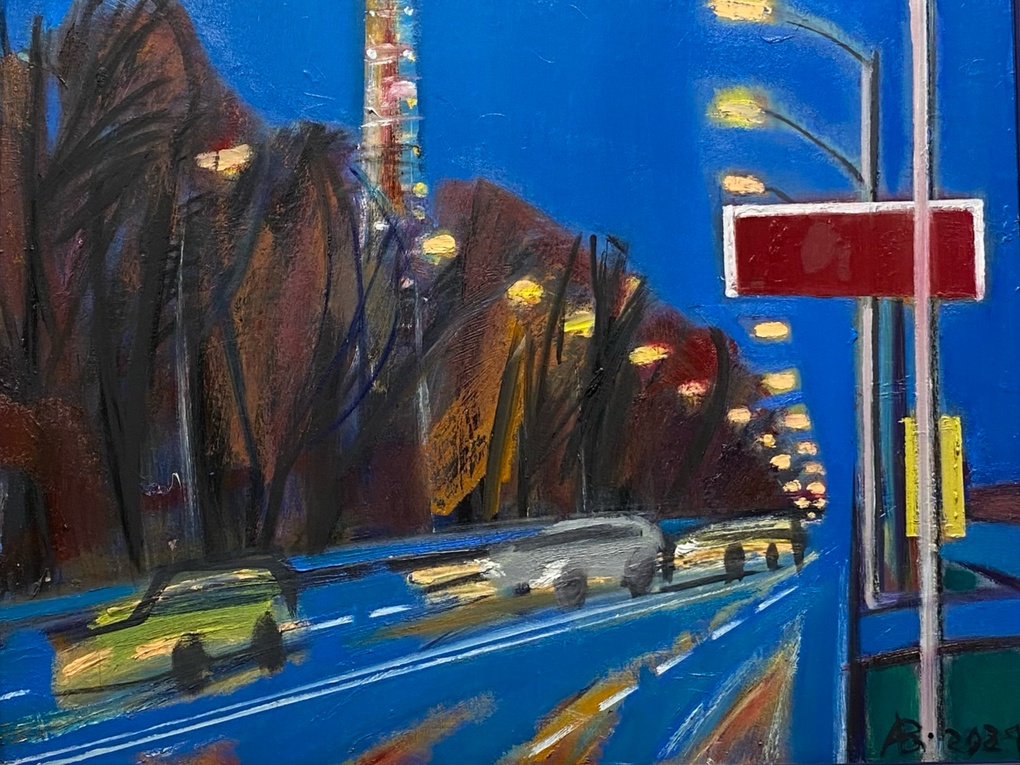
Night Avenue
Andrei VetrogonskyThis urban scene by Andrey Vetrogoński captures less a specific street than a condition of modern life: cold blue atmosphere, a chain of streetlights, and the pulse of transit turn the avenue into a metaphor of time and passage. The composition is driven by a strong vanishing perspective and the repeated cadence of luminous marks—an almost musical score in which each lamp sets the tempo, while the dark, wind-tossed trees act as theatrical wings. Cars and pedestrians are intentionally reduced to signs, heightening both the anonymity of the city and its seductive energy. A tight dialogue between saturated ultramarine and warm artificial light, reinforced by assertive brushwork and tactile paint handling, produces a sense of speed and immediacy. The blunt red road sign introduces a note of interruption—“stop” as a psychological counterpoint within an otherwise continuous flow. Market-wise, the work appeals to collectors of late modern urban lyricism and confident nocturne painting, where atmosphere and structure align with uncommon clarity.
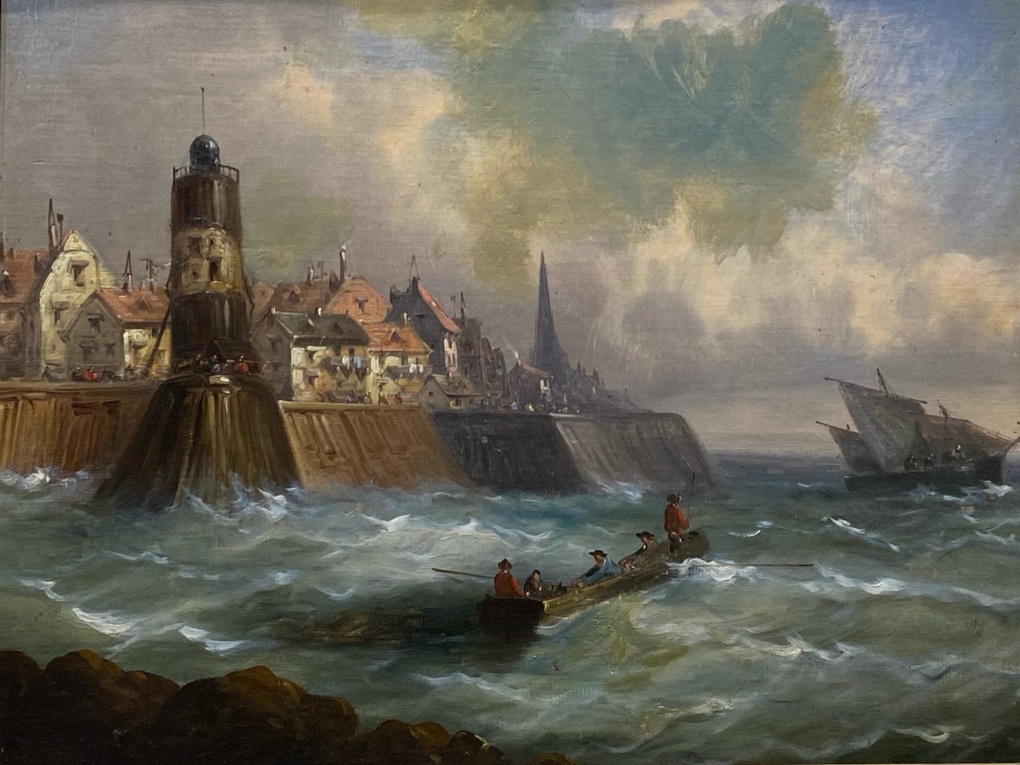
Storm at the Town Harbor
Unknown ArtistUnknown artist Late 19th century, France The painting depicts a seascape with elements of a coastal town. In the foreground is a restless sea with waves, across which a small boat carrying several human figures is sailing. A little further away, right by the shore, a massive lighthouse rises on a breakwater. The lighthouse serves as the central element of the composition, emphasising the drama of the scene. Behind the lighthouse lies a group of buildings with red roofs, evoking the feeling of a small port town. Among the structures stands out a tall, spire‑like church or tower, lending expressiveness to the architectural ensemble. In the background, the horizon features a ship with sails partially unfurled, adding a sense of dynamism to the scene. The sky is covered with thick clouds, creating a gloomy, slightly uneasy atmosphere. The painting’s colour scheme is predominantly cool: grey, blue, and green hues dominate, punctuated by warm tones from the roofs and the clothing of the people. The waves are rendered with particular expressiveness — the white foamy crests emphasise the power of the elements.
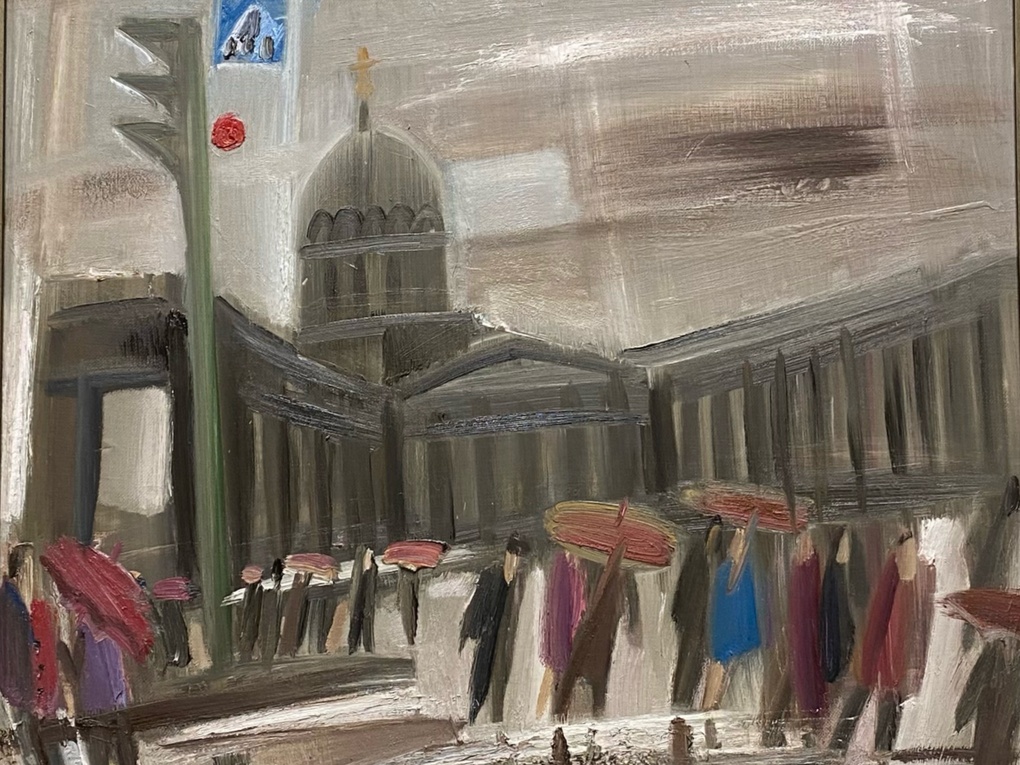
The Red
Andrei VetrogonskyThe painting depicts a rainy day in Saint Petersburg. We see the Kazan Cathedral, Nevsky Prospect, and people in motion. The artwork presents a vivid clash of two worlds: monumental architecture and a fragile human mass. At the centre of the composition stands the majestic Kazan Cathedral of Saint Petersburg: its dome with a cross and elongated façades establish an axis of authority and tradition. The recurring motif of umbrellas transforms passers‑by into a rhythmic «score» of colourful patches, creating a lively contrast to the monumentality of the cathedral. The artist deliberately avoids portraiture: figures are reduced to signs. This emphasises both the anonymity of the metropolis and, at the same time, the collective movement that seems to pulse at the foot of the historic monument. An earthy grey palette with accents of red and blue works as a form of drama. Colour here serves not a decorative purpose, but acts as a marker of presence and inner tension: the bright spots of umbrellas and passers‑by’s clothing «bring to life» the austere architectural backdrop. The gestural painting style, with visible brushstrokes and blending, creates a damp atmosphere — perhaps it is a rainy day in St Petersburg — and enhances the effect of sliding perspective, as if the city and its inhabitants are in constant motion.
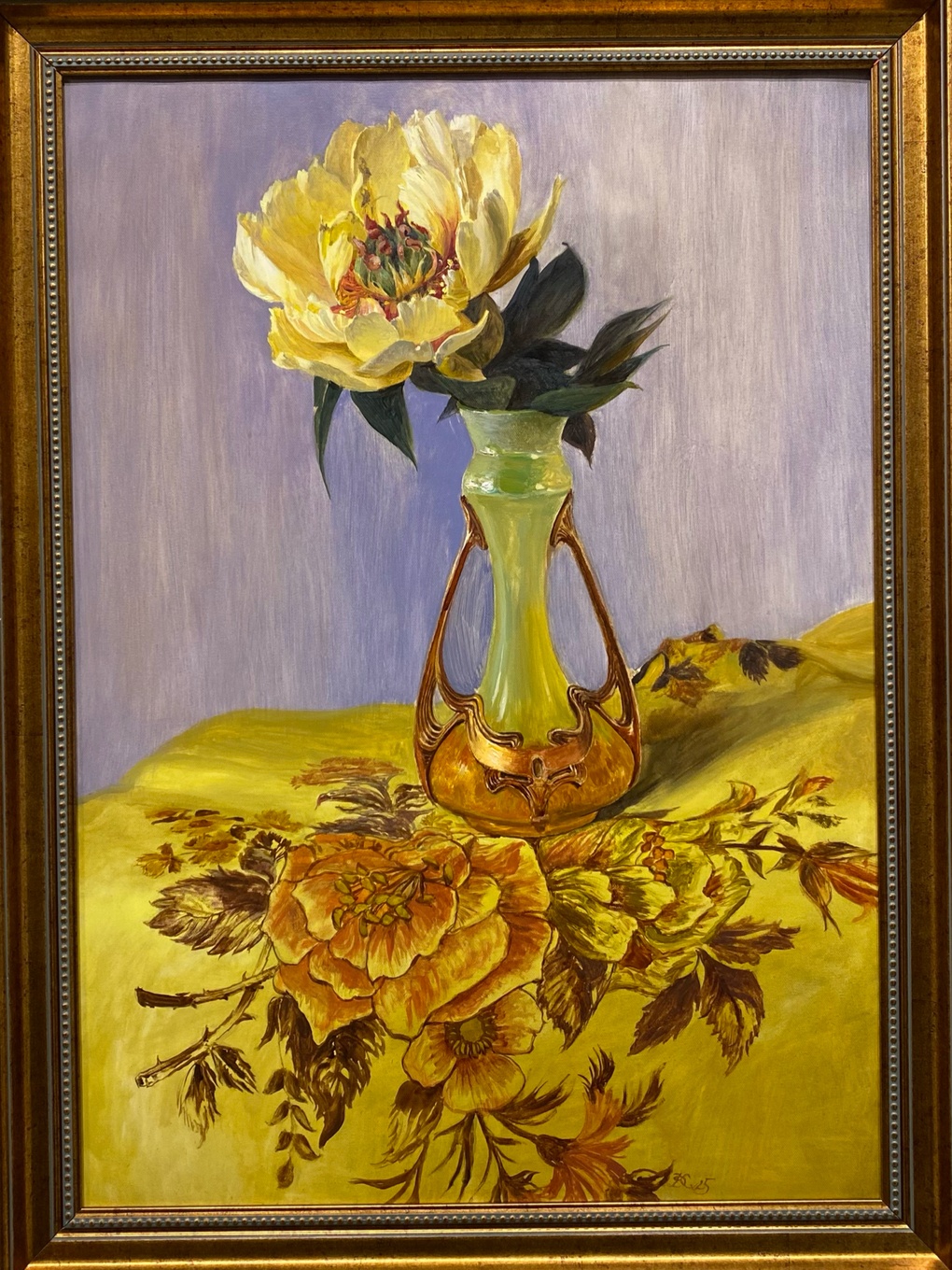
Yellow Peony in a Glass Vase
Dmitry KrasnovThis painting is a classic still life executed in the oil painting technique. At the centre of the composition is an elegant glass vase with decorative metal elements, holding a large yellow peony with expressive petals and dark accents in the centre. The artist skillfully plays with the contrast between the delicacy of the flower and the strict geometry of the vase. The background is rendered in calm lilac tones, which helps to highlight the main subject and creates an atmosphere of tranquillity. The vase sits on a surface covered with fabric featuring a large floral pattern in yellow‑brown hues — this element adds depth and decorativeness to the composition, evoking a sense of homely comfort. The composition is balanced: the flower occupies the upper third of the canvas, while the patterned fabric fills the lower part, forming a harmonious triangle. The colour scheme is warm, dominated by yellow, green, and brown tones, which gives the work a sunny, life‑affirming mood.
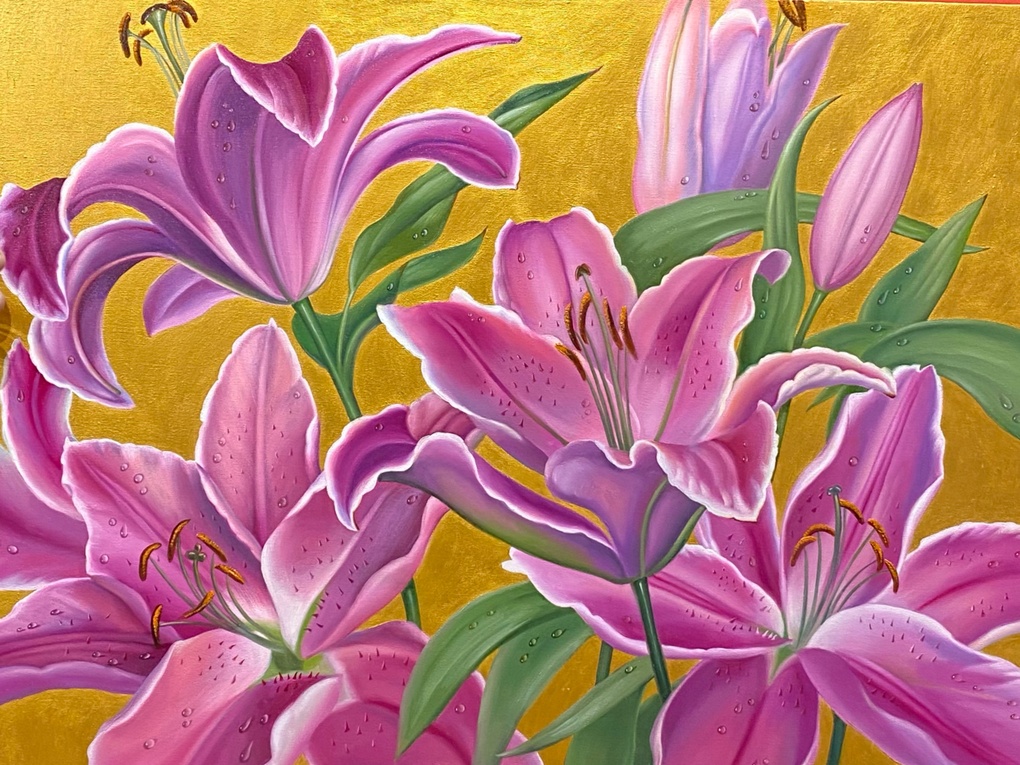
Lilies on a Gold Ground
Farida KapshanovaThe painting depicts a lush bouquet of lilies rendered in rich violet‑pink hues. The flower petals are depicted in great detail, with soft colour transitions and expressive veins, which gives them volume and realism. Dew drops are visible on the petals, creating a sense of freshness and morning coolness.The green leaves harmoniously complement the composition, accentuating the vibrancy of the flowers. The background of the painting is executed in a warm golden‑yellow colour, which contrasts beautifully with the cool tones of the lilies and makes the flowers even more striking. The composition is dynamic: the flowers are arranged at different angles, creating a feeling of naturalness, as if the bouquet had just been gathered and placed on the canvas. The painting conveys both sophistication and natural simplicity, evoking associations with a summer garden and the fragrance of fresh flowers.