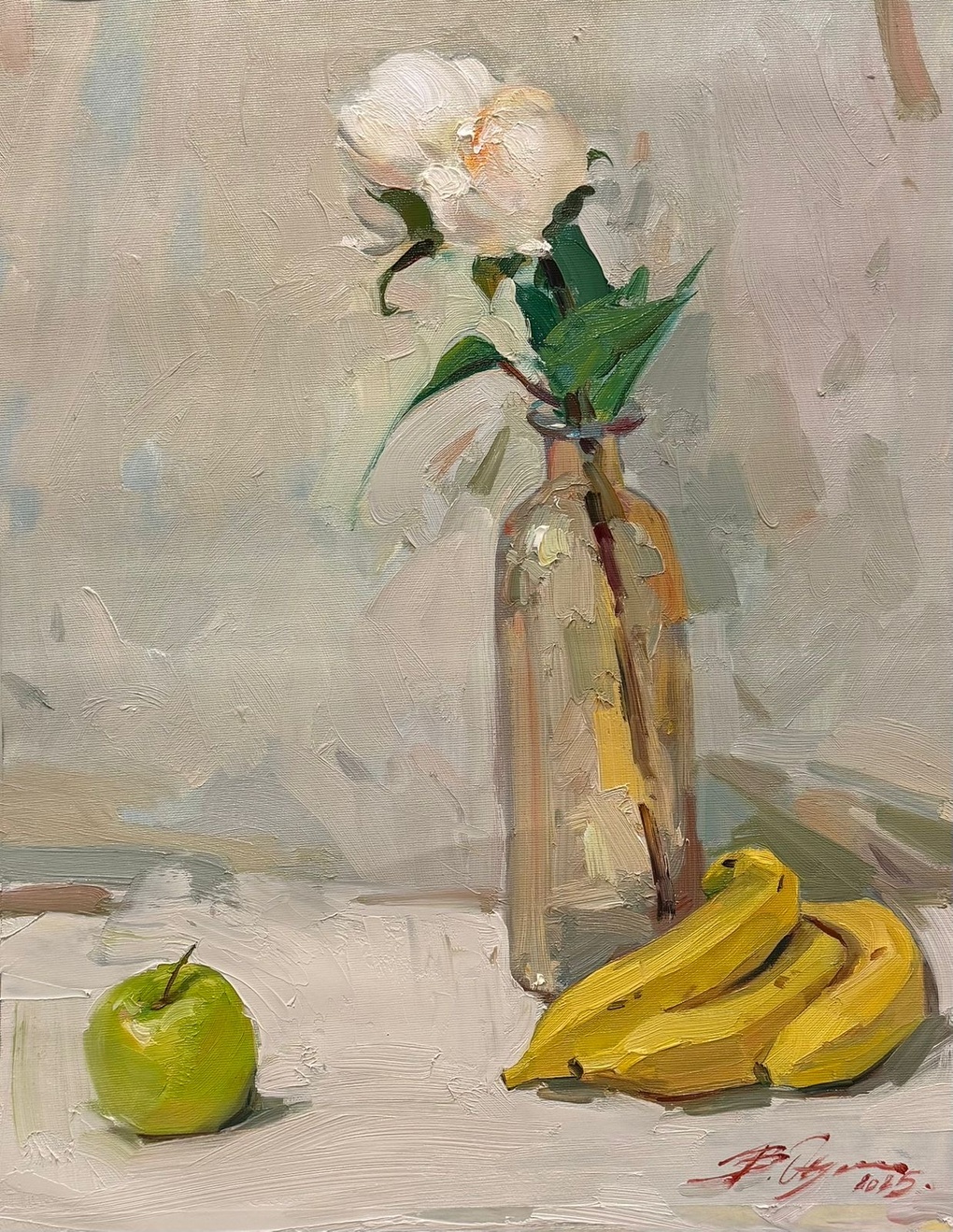
White Rose, Bananas, and Green Apple, 2025
A concise still life rendered in a soft, restrained palette. At the center of the composition is a transparent glass vase with a single white rose and expressive green leaves; the texture of the glass is accentuated by painterly brushstrokes. To the left is a green apple, to the right a bunch of yellow bananas: their simple, recognizable forms create a calm rhythmic balance. The background is painted in muted gray‑beige tones—it does not distract from the objects but rather emphasizes their materiality. The characteristic dense, impasto technique lends the canvas tangible plasticity and depth. The composition exudes tranquility and contemplation, while the restrained color scheme and expressive texture evoke the traditions of the realist school with elements of impressionistic freedom of brushwork.
Otgoo Badam
Otgoo Badam (born 10 September 1984, Ulaanbaatar, Mongolia) is a contemporary Mongolian artist whose practice combines academic tradition with expressive painting and national motifs. At the age of 12 he won first prize at an international children’s painting competition in the Czech Republic—his first major recognition. From 1999 to 2002, Badam studied at the Rajiv Gandhi Vocational and Craft School, receiving a diploma in leathercraft; in 2002–2004 he studied decorative and applied arts at the Institute of Fine Arts of Mongolia. In 2003 he won a still-life competition organized by the Japanese artist Tamuki. He continued his education in 2004–2008 at the Voronezh State Academy of Arts (easel painting department), and later transferred to the Ilya Repin St. Petersburg State Academic Institute of Painting, Sculpture and Architecture (easel painting department, studio of V. S. Pesikov). In 2012 he graduated with honors and became a member of the Union of Artists of St. Petersburg. In 2013 he took part in painting an Orthodox church in Italy.
Badam’s work synthesizes academic realism, expressionism, and Mongolian national themes. His paintings are marked by energy, dynamism, and an intense sense of life, echoing the expressive power associated with Nikolai Feshin and Valentin Serov. He integrates rigorous academic technique with expressive methods, drawing inspiration from Mongolian culture as well as the traditions of Russian portraiture of the 19th–20th centuries. Key subjects include the nature of Mongolia (steppe and mountain landscapes), questions of human existence and spirituality, historical and monumental compositions, and portraits that convey the inner world of the sitter. Viewers respond to the emotional intensity of his energetic brushwork, bold contrasts, and the internal movement of his compositions. Badam is a confident colorist, employing saturated, deep tones to build atmosphere and combining warm and cool hues with nuance. He works across landscape, portraiture, and still life, and also produces historical and monumental works.
Notable exhibitions include participation in the group show “Paths and Roads” at the Central House of Artists (Moscow, 2012), a solo exhibition at Tsagaandarium Art Gallery & Museum (Ulaanbaatar, August 2012), a solo exhibition at 976 Art Gallery (Ulaanbaatar, December 2012), and a solo exhibition at the Embassy of Mongolia in Moscow at the Konosier gallery (June–July 2013). A highlight was the exhibition “Steppe Wind. Otgoo Badam” at Konosier in Moscow (6 June–5 July 2013), presenting around 50 works. Badam’s works are held in private collections in France, Belgium, Finland, China, Mongolia, and Russia, reflecting the international reach of his practice.