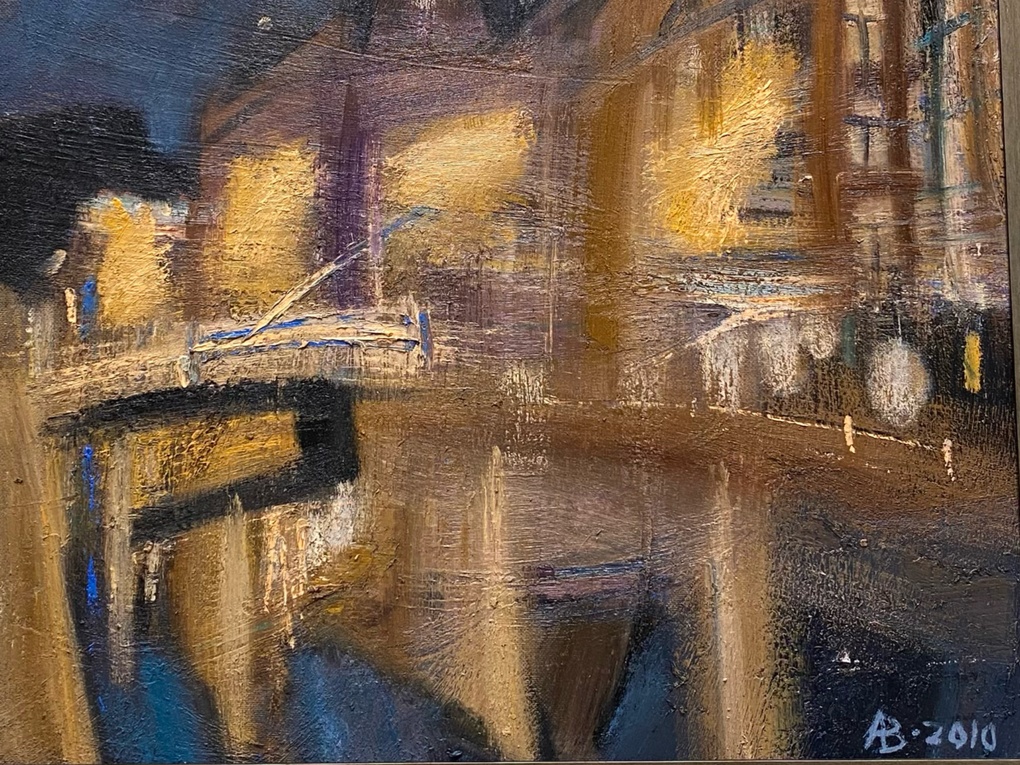
Night City: Lights and Reflections
This is a night city — not seen through the eyes of a tourist, but experienced as an inner sensation. Warm amber lights shimmer against a backdrop of cool blue shadows, creating the atmosphere of a fleeting moment: humid air, a barely perceptible movement, and a silence filled with life. The buildings and cars here are not objects, but signs. The artist does not draw a map of the city, but conveys its “psychological temperature” — something that cannot be measured, but can be felt. The surface of the canvas lives its own life: pastose brushstrokes create texture, retouches or glazes (scraping‑back effects) reveal hidden layers, and the light appears to be scratched through the paint — this is how shop windows and panes become sources of inner glow. The wet asphalt captures reflections, blurring the shapes without erasing them — on the contrary, it enhances the impression, like a memory that preserves not the details, but the emotions.
Andrei Vetrogonsky
Born in Leningrad in 1956, graduated from the Ioganson Academic Art Lyceum, and then in 1981 from the Institute of Painting, Sculpture and Architecture named after I. E. Repin. Since 1981 a member of the Union of Artists. His works are held in the Moscow Museum of Modern Art, the State Museum of the History of St. Petersburg, the Research Museum of the Russian Academy of Arts, the Vologda Regional Art Gallery, the Murmansk Regional Art Museum, the Sakhalin Regional State Art Museum, and the Cherepovets Museum Association. His works are also included in the encyclopedia 'Three Centuries of Russian Still Life' (Lev Mochalov). Since 1976 he has participated in more than 100 exhibitions: city, regional, republican, all-union, and international. Solo exhibitions: 1989, 1994, 2001, 2007 in St. Petersburg; 2001 in Murmansk; 1990 in Clermont-Ferrand, France. The main focus of his painting is the urban landscape, particularly the rivers and canals of St. Petersburg.