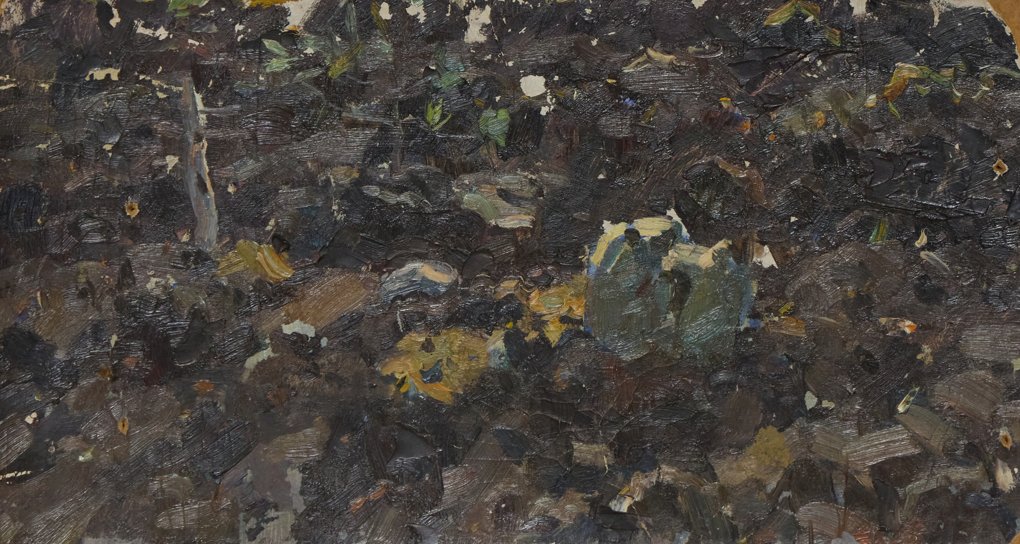
Plowed field
The artwork by Evgeny Lesin is a profound exploration of textures and tones found in natural landscapes. Dominated by dark, earthy colors such as deep brown, green, and grey, the painting creates a rich, textured surface. The bold brushstrokes and layers of paint add depth and complexity to the composition, evoking a sense of natural chaos. Despite the absence of specific objects, the painting elicits an emotional response, inviting the viewer to contemplate the natural elements and their interactions. Lesin's work, created in the style of Realism, draws attention to the simple beauty of the earth, showcasing the artist's mastery in capturing the essence of nature.
Evgeny Lesin
Outstanding Soviet painter and graphic artist, member of the Union of Artists of the USSR, representative of the Leningrad School of Painting. Born 29 December 1917 in Penza. In 1936–1939 he studied at the Leningrad Secondary Art School at the All-Russian Academy of Arts. In 1939 he was admitted to the painting department of the Leningrad Institute of Painting, Sculpture and Architecture named after I. E. Repin, and in the same year was conscripted into the Red Army. A veteran of the Finnish War and the Great Patriotic War. After demobilization in 1945, Lesin returned to the institute. He studied under L. F. Ovsyannikov, M. I. Avilov, I. P. Stepashkin, and Yu. M. Neprintsev. In 1951 he graduated with the qualification of painter-artist, presenting his thesis 'In Stanislavsky's Studio at Rehearsal', and was accepted as a member of the Leningrad Union of Soviet Artists. From 1951 he participated in exhibitions, painted thematic pictures, portraits, and landscapes. In the late 1980s–early 1990s his works were presented at exhibitions and auctions of the Leningrad School of Painting in France. Notable paintings: 'To Native Places' (1959); important exhibitions: 'Soviet Russia' (1960). Evgeny Konstantinovich Lesin died 4 May 2000 in St. Petersburg. His works are held in museums and private collections in Russia and abroad.