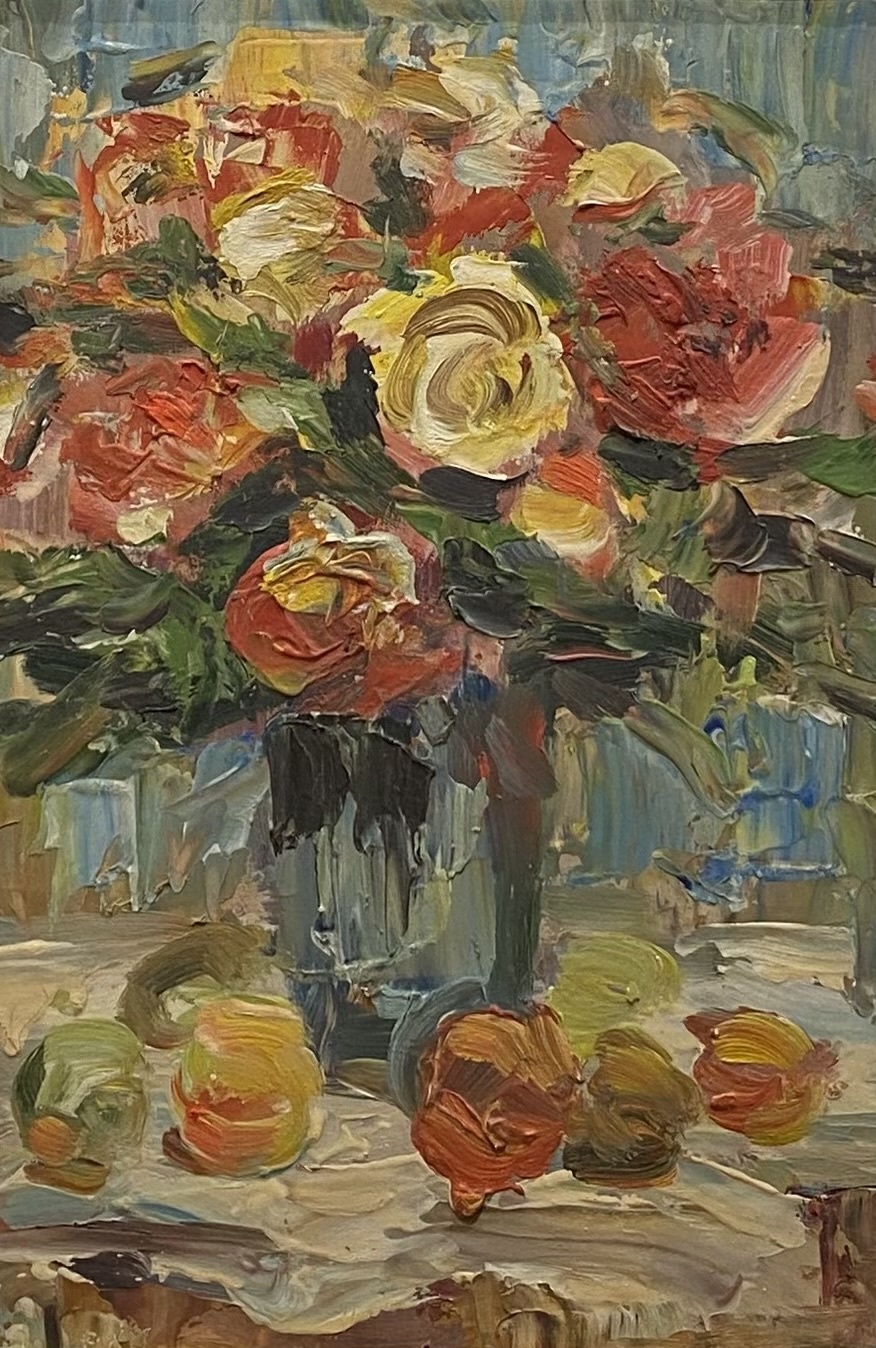
Bouquet with Fruit
The still life with a bouquet of roses and fruit is a vivid example of how Alexander Irkha’s key artistic principles come together in a single work. At the centre of the canvas is a lush bouquet: the flowers are painted with thick, almost sculptural brushstrokes, as if moulded from paint. This impasto technique is Irkha’s signature approach—he doesn’t so much draw as “sculpt” the form, making active use of a palette knife. Thanks to this technique, the canvas surface becomes textured, and the light falling on it creates deep shadows and bright highlights—making the flowers seem almost tangible. The colour scheme is built on a bold contrast: the warm, saturated hues of the roses—red, terracotta, yellow‑cream—sound open and intense, while the cool grey‑blue background accentuates them effectively. This approach aligns Irkha’s style with the Fauvist freedom in handling colour: the artist sacrifices naturalism for emotional impact, seeking to convey not so much an exact likeness as the power of the impression. Despite the expressiveness of the brushwork, the composition remains strict and cohesive: the bouquet is centred, the rounded shapes of the fruit in the foreground balance its mass, and the background, sketched with broad, loose strokes, doesn’t compete with the main subject. This is the essence of Irkha’s creative method: a fusion of academic discipline and “rebellious” freedom. His solid Leningrad education gave him a firm grounding in drawing and a sense of form, while his affiliation with the “quiet” wing of the Leningrad underground of the 1970s–1990s gave him the courage to experiment with texture and colour.
Alexander Irkha
Alexander Irkha was born in 1946. He lived and worked in Leningrad (later St Petersburg). The artist received a solid academic art education, either at the Vera Mukhina Leningrad Higher School of Art and Industry or at the graphics/painting faculty of the Repin Institute.
In the 1970s–1990s, Irkha became a notable figure in the Leningrad underground, associated with its “unofficial” or “quiet” wing. At that time, many artists who did not fit within the boundaries of official culture sought alternative paths, organizing apartment exhibitions and working outside the system of the Artists’ Fund. Irkha did not seek wide public recognition, yet his mastery places him alongside other significant representatives of the period.
Irkha worked in the manner of expressive realism. His style is readily recognizable for its impasto technique and thick brushwork, as well as his active use of the palette knife to create textured, almost sculptural surfaces, as though he were modelling space. He was drawn to pure, vivid, Fauvist colour. Overall, his manner represents a successful synthesis of rigorous academic draftsmanship and bold, almost rebellious use of colour.
Recurring themes in his work include an in-depth exploration of human character through sharp contrasts of light and shadow and the psychological depth of his figures; reflections on turning points in history through biblical and metaphysical questions; and the relationship between nature and humankind, with emotional states conveyed through landscape and composition. The 1970s and 1980s were a particularly active period of artistic exploration: Irkha worked within the USSR Artists’ Fund system and took part in plein-air painting trips, during which his distinctive style took shape.
Alexander Irkha’s paintings are held in private collections, including in St Petersburg.